
Most rental outfitters hand you a boat, a paddle and a life jacket. Nobody hands you the clothes.
For a summer paddle on warm water, that is fine. What is already in your wardrobe will do, with two or three swaps.
Clothing turns into a safety question only when the water is cold. That question has a number attached, and it is not the one on the weather app.
Dress for falling in, not for sitting in the sun.
What the outfitter gives you
A rental usually includes:
- The kayak and a paddle
- A life jacket sized to you
- Sometimes a dry bag or a backrest
Very few places provide clothing of any kind.
They cover flotation. You cover everything that touches your skin.
Ask what is included when you book rather than when you arrive. Sizing a life jacket at the counter takes a minute and is worth doing slowly.
Once you paddle often enough to buy your own, choose a life jacket comfortable enough to keep on all outing.
If you have not settled on a boat yet, sit-on-top and sit-inside kayaks behave differently in a capsize. That changes how wet you expect to get.
Start with the water, not the sky
The National Weather Service puts the rule in one line. Always dress for water temperature, not for air temperature.
Warm air on your face says nothing about the water under the hull.
The agency’s own reasoning is that warm air does not always mean warm water in lakes, streams or oceans. That gap is widest in spring and again in late autumn.
The National Center for Cold Water Safety draws its line at 70°F. Below that water temperature it treats proper cold-water gear as essential rather than optional.
Above 70°F water, clothing is a comfort decision. Below it, it stops being one.
Checking the temperature before you drive out takes a minute. That minute matters because of what cold water does in the first sixty seconds.
Warm air on your face says nothing about the water under the hull.
Why a rain jacket does not count
This one catches people who already own decent outdoor clothing.
The National Center for Cold Water Safety is clear about it. Raingear is fine for hiking in wet weather, but it offers no protection once you are actually in the water.
The distinction is between waterproof and watertight. A rain shell sheds spray from above and floods the moment you go under.
That does not make a rain shell useless. On a breezy day a light shell blocks wind and keeps splash off, which is most of what summer paddling asks for.
It simply is not thermal protection. Nothing in an ordinary wardrobe is.
What to wear on a warm-water day
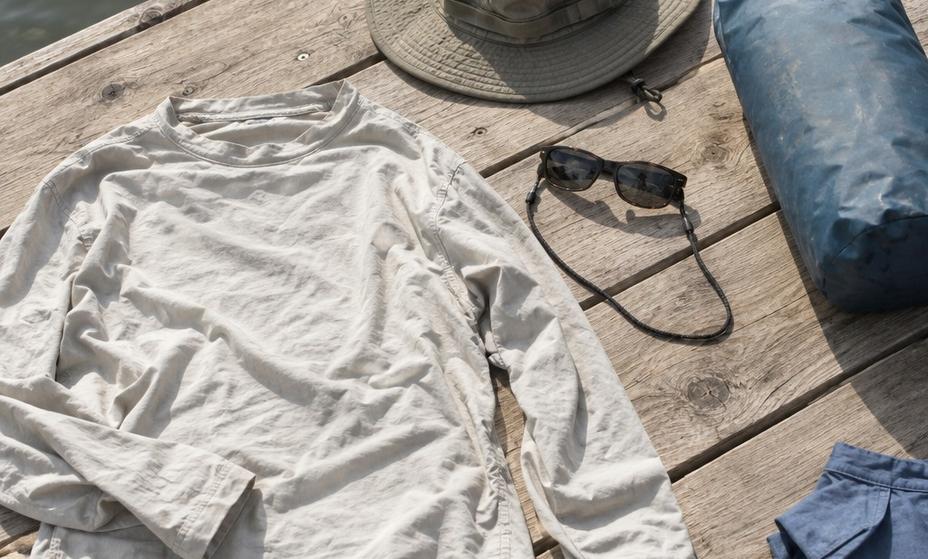
Assume you will get splashed, sit in a wet seat, and finish damper than you planned.
What works, straight from a normal wardrobe:
- Synthetic or wool next to the skin, never cotton
- Quick-drying shorts or light trousers, nothing heavy
- A long-sleeved shirt you can push up, for sun as much as warmth
- A thin wind layer for the paddle back
- A brimmed hat that stays on, and sunglasses with a retainer
Cotton is the one swap that really matters. It holds water, stays cold against the skin, and takes hours to dry in a light breeze.
Leave cotton in the car, including the socks.
Worth sealing into a dry bag:
- A dry shirt for the drive home
- Water, more than you think
- Your phone
- Sunscreen for a second application
Shoes are the part people get wrong
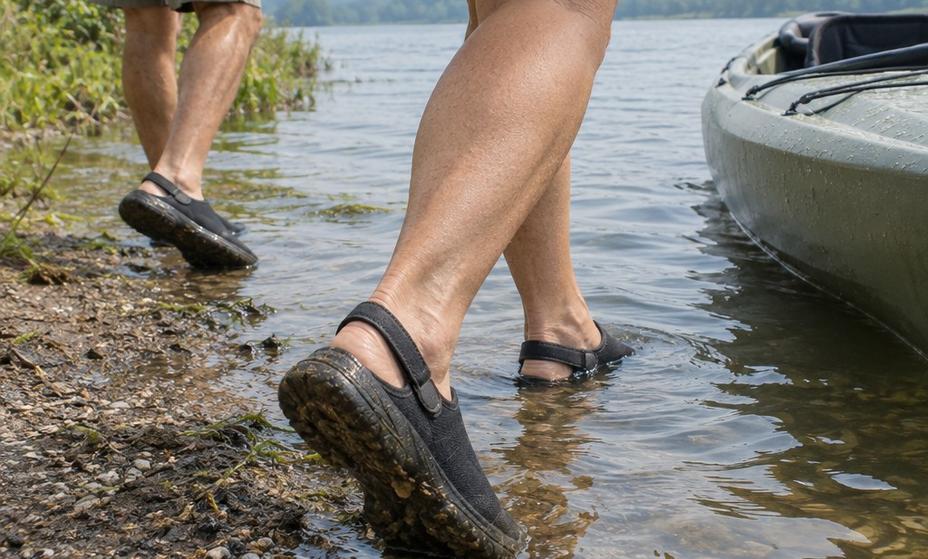
Bare feet and flip-flops are the two commonest choices, and both cause trouble.
Launch areas are gravel, mud, weed or something sharp, and you stand in all of it while getting into the boat from shore.
What you want is a shoe that stays on when wet and lets water back out.
Old trainers you do not mind soaking are fine. So are water shoes, or sandals with a heel strap.
The test is whether the shoe stays on your foot when you pull it out of soft mud.
Flip-flops fail that test every time, and they float away.
Sun is stronger on the water
Open water reflects, and there is no shade in the middle of a lake.
The EPA, the US federal environment regulator, calls for protection from a UV Index of 3 upward, which covers most of a US summer day.
Its guidance at that level is broad-spectrum SPF-15 or higher on exposed skin, plus protective clothing, a wide-brimmed hat and sunglasses.
There is also a check that needs no app. If your shadow is shorter than you are, UV exposure is high.
Midday UV is the strongest of the day, which is also when most rentals go out.
Cover the backs of your hands and the tops of your feet. Both spend the whole trip pointed at the sky.
When the answer is to wait
If the water is below 70°F and you own no immersion gear, the right call is usually a different day.
That is not caution for its own sake. Cold shock is a physical reaction, and it does not care how fit or how calm you are.
No clothing you already own buys you time in cold water. Only a wetsuit or a drysuit does.
This is general water-safety information rather than medical guidance. A heart condition makes the cold-water question one to put to your doctor first.
Most outfitters run their season while the water is warm, which is part of why a summer rental asks so little of you.
For a July afternoon on a warm lake, you already own everything you need.