
A life jacket you’ll keep on has to be comfortable enough to wear all outing. For a kayak with a tall backrest, try sitting in the seat with the vest on.
The default pick here is the Onyx MoveVent Dynamic Paddle Vest.
The Astral Layla is cut for women. The other three are not sold as women’s-specific.
Links to Amazon on this page are affiliate links, so a purchase through one pays this site a small commission and costs you nothing extra.
| Where you'll use it | A sensible first pick |
|---|---|
| First-time buyers who want mesh ventilation and three chest sizes | Onyx MoveVent Dynamic Paddle Vest |
| Anyone who wants a Type III rating on the maker's page | NRS Vapor PFD |
| Women who want a women's-specific cut | Astral Layla |
| Larger chests, up to 65 inches | Onyx Universal Paddle Life Jacket |
Onyx MoveVent Dynamic Paddle Vest
A first vest whose maker says it clears most kayak seats
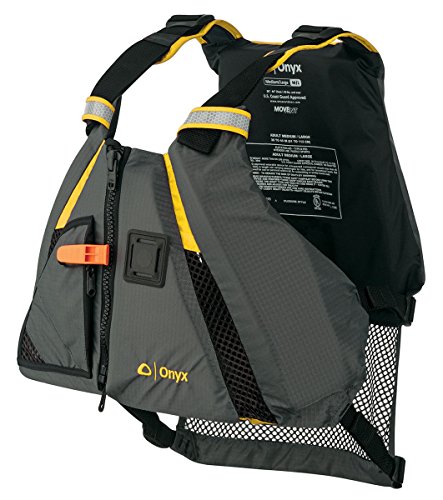 Onyx MoveVent Dynamic Paddle Vest
Mesh back panel for most canoe and kayak seats
Neoprene shoulder pads and adjustable side belts
Check stock and price on Amazon
This is the default pick for a first vest. For comfort, it has mesh ventilation front and back, neoprene pads at the shoulders and adjustable side belts.
It also has a zippered pocket and a marine whistle, and it carries approval from the U.S. Coast Guard and Transport Canada. Sizes run in three chest ranges: 28 to 36 inches, 36 to 44 and 44 to 56. All are for wearers 90 pounds and over.
Defender identifies the MoveVent Dynamic series as US Coast Guard Type III. Check the label on your own vest for its approval, size and intended use.
NRS Vapor PFD
A foam vest with padded shoulders and a six-panel fit
 NRS Vapor PFD
Six-panel soft foam
Padded shoulder straps
Check stock and price on Amazon
This is the plain, no-frills vest. Six foam panels wrap the torso, with padded shoulder straps and adjustments at the sides, shoulders and waist.
NRS identifies the 2021 Vapor as a Type III vest. Check the approval label on the vest you receive.
Chest ranges run from 30 to 56 inches across three sizes. The listing linked here is XL/XXL, for chests of 50 to 56 inches. Measure your chest against NRS’s chart before choosing a size.
Astral Layla
A women's-specific cut with a Type III rating
 Astral Layla women's life jacket
Women's-specific fit, USCG Type III
16.3 lb design buoyancy, 3/4 side zip entry
Check stock and price on Amazon
This is the pick for a women’s-specific cut. Astral says hinged princess seams, sculpted chest cups and organic kapok (a natural plant fiber) shape the fit, and that it suits touring, stand-up paddleboarding and whitewater.
Entry is a 3/4 zip at the side. Chest sizes run from 27 to 51 inches across four sizes, so measure your chest against Astral’s chart.
Onyx Universal Paddle Life Jacket
Two broad sizes, adjusted with six straps
 Onyx Universal Paddle Life Jacket
High foam back with mesh lower back
Six adjustment straps, two sizes
Check stock and price on Amazon
This is the pick for a broad range of builds in one vest. Universal fits chests of 30 to 52 inches, and Oversize fits 45 to 65. Both are for 90 pounds and over.
Six adjustment straps do the fitting. Onyx says the foam is flex-cut for a low-profile fit and that the vest is U.S. Coast Guard approved. Neoprene shoulder pads and a large front pocket come with it.
Onyx says the high foam back suits high-back seats, but NRS advises a mesh or thin foam back for those, so check the fit against your own seat.
- Think twice if
- Anyone who wants more than two sizes
Reading the label
The U.S. Coast Guard Boating Safety Division sorts wearable life jackets by performance Type or Level. Type III is intended to support a conscious person in the water in an upright position.
Level 70 is for people who have help or a means of rescue close at hand, or who are near bank or shore.
For a kayak vest, look for either Type III or Level 70 on the label. A bold 70 means Level 70, which performs similarly to the older Type III. Older Type labels are still approved. Check the label for the user weight and chest size too.
High-back kayak seats
NRS advises choosing a jacket with a mesh or thin foam back if your kayak has a high seat back. It also suggests large arm holes and multiple adjustment straps, because kayaking needs good upper body and arm mobility.
If you’re renting, ask the outfitter whether their boats have high seat backs.
Only the two Onyx vests come with a maker’s seat claim. The MoveVent has a mesh back panel, and the Universal has a high foam back with a mesh lower back.
The fit test
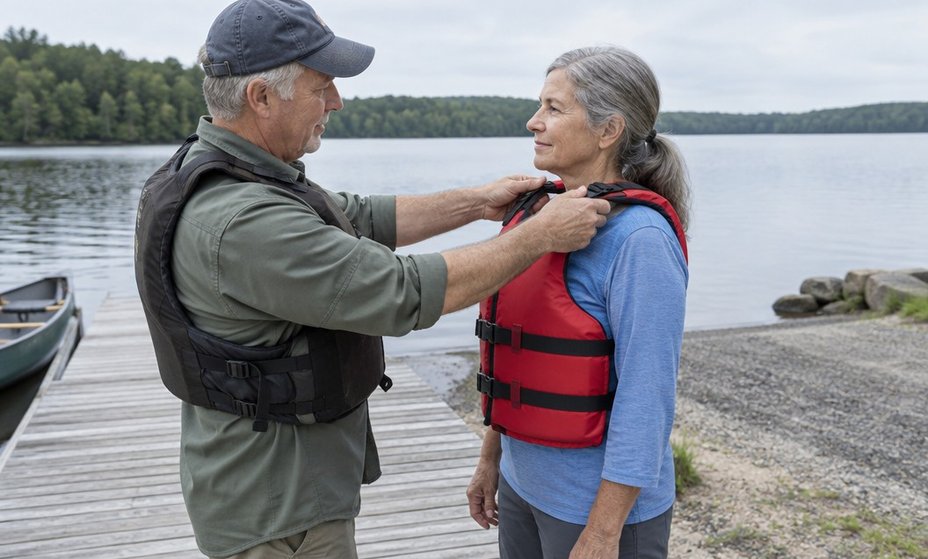
As the American Canoe Association puts it, the best type of life jacket is the one you’ll wear. Test it for a snug fit that doesn’t ride up over your chin.
You can do this test in a shop before you buy, or as soon as the vest arrives while returns are open. The one-inch guideline in the arms-up check comes from the Oregon State Marine Board.
- Loosen, then wear. Loosen every strap, then put the vest on.
- Anchor the lower strap. Cinch the lower strap below the rib cage. This anchors the vest so it doesn’t ride up.
- Close everything. Buckle every buckle and zip every zipper, then tighten the shoulder straps last.
- Raise your arms. Raise your arms straight up. The vest shouldn’t come more than one inch off your shoulders.
- Lift at the shoulders. Have a helper grab the vest at the shoulders and lift. If it rides up over your chin or ears, retighten the lower strap or choose another vest.
Inflatable belt packs
A belt pack is slim, but it asks more of the wearer than a foam vest does. With the Onyx M-16, inflating the pack and getting it into position are two separate steps. Follow the instructions on the pack for both.
The Coast Guard Boating Safety Division says inflatables aren’t appropriate for weak swimmers or non-swimmers. BoatUS notes they’re authorized only for wearers at least 16 years old, and the Oregon State Marine Board doesn’t recommend them for less mobile adults either.
Manual packs inflate with a quick jerk of a cord, and automatic ones inflate in water. Both need a yearly test and new cylinders after use or expiry.
The National Weather Service says gasping from sudden immersion can be triggered by water as warm as 77°F.
A beginner is better off with a foam vest, which floats without the wearer doing anything.
When the rental vest is enough
Check that the rental vest is Coast Guard approved for paddling, is in good condition and passes the fit test above.
Buying makes sense once you paddle regularly. It also makes sense if you want a vest you’ve already adjusted to fit.
The Coast Guard Boating Safety Division notes that most boating drownings happen on nice days. A calm outing is no reason to leave the vest off.
Before you step into the boat
On cold water, water temperature matters more than air temperature, and cold shock is a reason to have the vest on already.
A vest is one of several beginner kayaking safety rules, alongside checking the weather and wind.
If you’re renting and own no gear, plan what to wear kayaking around the water temperature.
Keep the life jacket on for the whole time the boat is underway.
Put yours on, buckle every buckle and zip every zipper before you step into the boat.