
Two things come first: how calm your dog stays around distractions, and how competent you are in the boat.
Sarah Mairs, quoted by the American Kennel Club (AKC), the world’s largest not-for-profit dog registry, believes anybody competent with a kayak can include their dog. The dog trainer’s condition is that they’re willing to teach some basic skills.
She also advises that if your dog can’t show control around distractions, you aren’t yet ready to kayak together.
This isn’t veterinary advice. If your dog is older or has a health condition, ask your vet before the first outing.
Control around distractions and your own kayak skill decide whether you’re ready to launch.
Is your dog a good fit?
The National Park Service, the US government agency that preserves the national parks, gives paddlers a starting tip on its Buffalo National River page. Know your dog’s abilities, temperament and stamina.
Three things to check:
- Control around distractions, the test Mairs sets.
- Comfort around water. Jennifer Fish, owner of Dogs Gone Swimming Wellness Center in Portland, Oregon, says not every dog enjoys being in the water.
- Stamina. An AKC water-safety article says time on the water can be more physically demanding for dogs than many owners realize.
The park service adds a warning. Unfamiliar sights, sounds and smells can make even a calm, friendly dog behave unpredictably.
If your dog repeatedly avoids the water or appears stressed, don’t force the experience.
Choosing and fitting a life jacket
Trainer Sassafras Patterdale, writing in another AKC article, says a dog should wear a life jacket even if it’s a strong swimmer.
A National Park Service page for Delaware Water Gap says it is highly recommended that a pet wear one on the river.
The Buffalo River page adds that a life jacket makes it much easier to retrieve your dog after an accident.
What to look for in a jacket:
- A fit for your dog’s body type that allows fluid motion from the shoulder (Mairs)
- A snug fit around the neck, because Fish has seen dogs catch a front leg in a loose jacket
- A strong handle and solid clips rather than Velcro, which is Mairs’s preference
- Good condition, since Fish says a worn-out jacket can be dangerous
Ruffwear, a dog-gear company that makes dog life jackets, says sizing follows the dog’s rib-cage girth, measured just behind the front legs. For its own jackets, the company recommends the smaller size when a dog falls between two.
Mairs suggests letting a dog wear its jacket in the house, on walks and at mealtimes. It’s not a given that dogs will enjoy swimming with one on.
Renting a kayak? Patterdale notes that most boat rentals don’t have dog life jackets available, so plan to bring your own.
Fit it snugly, and let your dog wear it around the house before the trip.
Which kayak works best
Mairs says a sit-on kayak will allow for more space, and most dogs lie down when they relax. A sit-on kayak, also called a sit-on-top, has you sit on the deck instead of inside a cockpit.
A sit-on kayak gives your dog more room to settle.
The same page suggests adding padding and nonslip material for safe footing.
Patterdale adds a size note. A larger dog, or one that gets excited around water, may call for a larger, more stable boat.
How steady a boat feels depends partly on hull shape and width.
Practice on land, then in the shallows
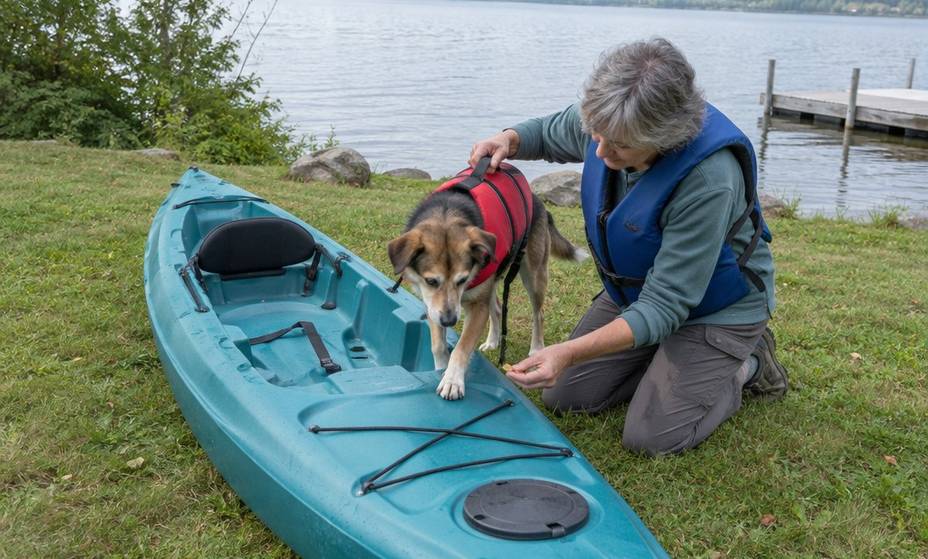
Mairs says early training should take place on land. A floating boat moves and rocks unpredictably, which can scare a dog and put it off future kayak adventures.
This assumes you can already handle the boat. If you’re still learning, the basics of entering the kayak and the forward stroke come first.
Work through the steps in order:
- Set the kayak on land, or beach it in shallow water. Let your dog get on and off on its own.
- Reward your dog for watching you rock the kayak.
- Get in yourself early, before asking your dog to climb all the way in, to show it’s safe.
- Build up to your dog touching the kayak, then getting in, rewarding at every step.
- Teach on and off cues, so your dog waits to be invited aboard and jumps off only with permission.
- When your dog gets on, stays on and gets off comfortably, move to the water.
If your dog shows signs of distress, give it a break and go back to an earlier step.
Patterdale adds that you shouldn’t force a dog to keep boating if it’s clearly uncomfortable.
Never tie or tether your dog to the kayak. Patterdale says so plainly, and the Buffalo River page gives the same warning alongside its life jacket advice.
Heat and water for your dog
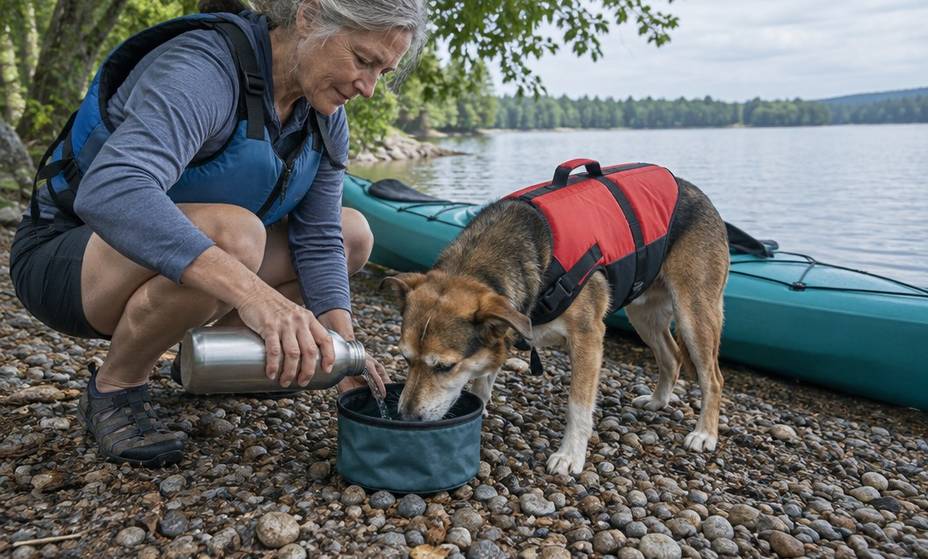
Cornell University’s veterinary college, through its Riney Canine Health Center, explains why heat is a concern. Dogs only have sweat glands on their paws and must rely on panting to cool down.
Heatstroke comes from hot or humid environments, or from overly strenuous exercise. An AKC article on heatstroke says a dog may suffer heatstroke when its internal temperature exceeds 105.8°F.
That’s the dog’s body temperature, not a weather reading. Heat, humidity and sun all raise the risk, so watch your dog for the signs below.
Cornell and the AKC name dogs at higher risk:
- Short-muzzle breeds
- Older or overweight dogs
- Thick-coated or dark-coated dogs
- Puppies, and dogs with underlying health issues
The AKC lists heavy panting, rapid breathing, excessive drooling and bright red gums and tongue among the early signs.
It says to spray or sponge your dog with tepid or cool (not cold) water. A veterinary visit is essential even if your dog appears to recover, it adds.
Patterdale says to bring ample water and watch for overheating in blazing sun. The AKC water-safety article also warns that drinking too much water while swimming can lead to water intoxication, which it calls potentially life-threatening.
Bring fresh drinking water, since dogs shouldn’t rely on lake, river or ocean water to stay hydrated.
When to leave your dog at home
The American Canoe Association (ACA), a national nonprofit paddling organization founded in 1880, ends its tip on overloading with a line about dogs.
Don’t overload your boat, the tip says: distribute passengers, secure gear evenly and low, and leave your dog on land.
The same poster says most paddlesport-related drownings are the result of capsizing. Weather, wind and your boat’s weight capacity are among the beginner kayaking safety rules.
A small boat loaded with you and your gear has no safe room for a dog.
Leave your dog at home when:
- It can’t show control around distractions.
- It repeatedly avoids the water or appears stressed.
- The boat would be overloaded with you, your gear and a dog.
- Heat could push a higher-risk dog toward overheating, since Cornell calls avoiding that situation the most effective prevention.
Unfamiliar sights, sounds and smells can make even a calm, friendly dog behave unpredictably.
The first trip
Pack fresh drinking water, and bring a life jacket that already fits.
For a dog’s first swim, Fish recommends calm, warm water with a gentle, sloping bank.
That kind of spot works for a first launch too.
Launch from a shallow entry point: beach the kayak there, and let your dog step in and out on its own before you push off.