
Rent a canoe if you’re going with a partner or bringing gear. Rent a kayak if you’re going alone.
The American Canoe Association (ACA) is a national nonprofit founded in 1880 that runs paddling education programs.
It says it’s easier to keep a kayak in a straight line when you’re alone. With a partner, its beginner guide from the early 2000s says, tandem canoeing can be a joy.
Sharon Brodin, writing for Bending Branches, a Wisconsin paddle maker, says that in her experience most beginners find kayaking easier to learn.
A kayak is easier to steer alone; a canoe has room for a partner and gear.
What a canoe is like
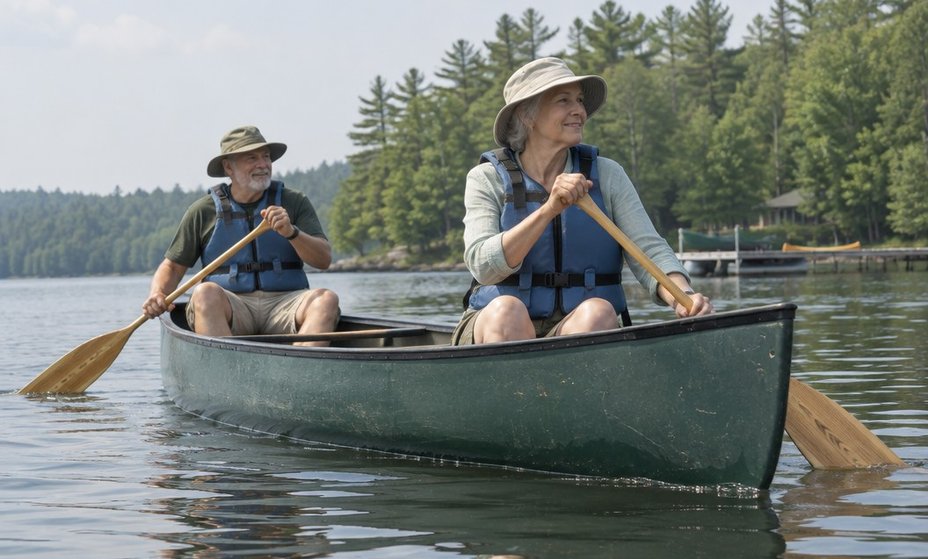
A canoe is an open boat with higher sides and ends than a kayak, according to Bending Branches. Here is what a first-time renter will notice:
- In a recreational canoe, the paddlers in the front and back sit on seats several inches above the floor.
- The paddler in the stern does the bulk of the steering, and the strokes take time and practice.
- In most canoes you’re safer kneeling than sitting, the ACA says, especially when it’s windy or bouncy.
- There’s room for the kids and the dog (ACA). Canoes can also hold more gear than kayaks, per Minnesota’s Department of Natural Resources in a 2004 article for young readers.
Colorado Parks and Wildlife, which runs Colorado’s state parks, covers the steering point in its magazine. A state park manager there writes that newcomers are the canoes going in circles.
Once you can paddle in a straight line, the column adds, it becomes much easier.
A canoe takes longer to steer well at first, and it gets much easier once you can paddle straight.
The National Park Service is the US government agency that preserves the national parks. It says to kneel in the bottom of the canoe in rough water, for stability.
If your back tires quickly, the ACA notes that a number of different back rests can be attached to a canoe seat.
With two people aboard, the ACA’s guide says:
- It’s easier to travel and to steer with a paddler in each end.
- Canoes run straight, fast and stable when one paddler on each side strokes to the same cadence.
- Without gear to balance the boat, the heavier paddler should sit in the rear.
The Minnesota article puts it in car terms: canoes are like pickup trucks, while kayaks are like sports cars.
What a kayak is like
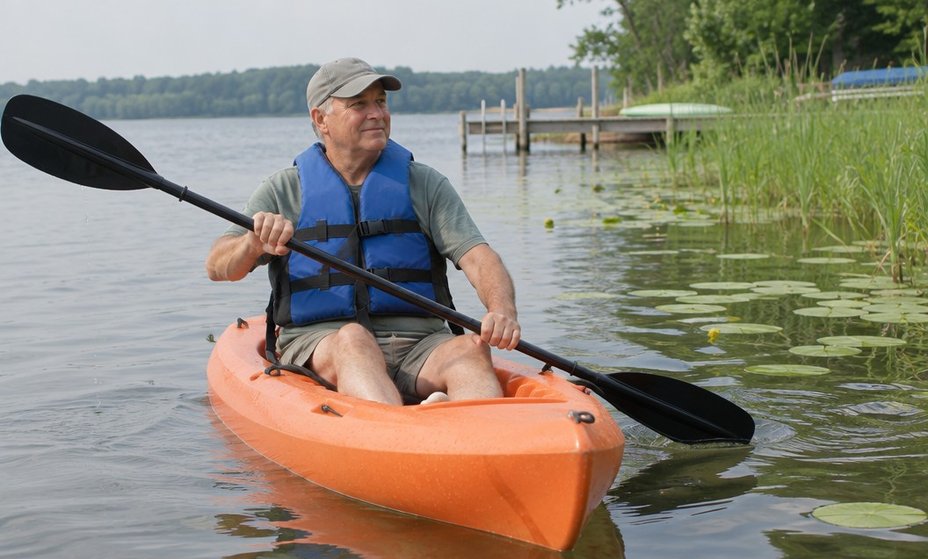
In a kayak, you sit much closer to the floor of the boat, even on it. Bending Branches says that lowers your center of balance by quite a bit.
Its writer adds that if you worry about tipping, a kayak will feel more comfortable as a new paddler.
Steering is simpler too, in one comparison. Bending Branches says a single recreational kayak with a double-bladed paddle can be steered accurately without knowing any real strokes at all.
That comparison is one person in a kayak against two in a tandem canoe, on flatwater.
The trade-offs are real, according to the ACA:
- Kayakers sit with their legs slightly bent in front of them, with less wiggle room than in a canoe.
- Kayaking is wetter and potentially more chilly.
- Different kayaks offer different seating options, including angle-adjustable back rests.
- Lightweight paddles decrease fatigue.
The ACA’s current safety slides say to dress for the water temperature, not just the air temperature. That is why what to wear when renting a kayak is worth settling before the day.
For beginners, the ACA calls sit-on-top kayaks especially suitable, because if you tip over you simply climb back on. If a kayak is your pick, the choice between sit-on-top and sit-inside kayaks is the next one to make.
Tandem boats, the ACA adds, give people who tire quickly more chances to paddle.
A kayak sits lower and is easier to steer at first, but it leaves less wiggle room and gets you wetter.
Stability and wind
The ACA says the wider the canoe or kayak, the more stable it feels when you first get in on quiet water. It lists 24 to 30 inches as the normal width of a recreational kayak.
Many recreational boats have flat bottoms for that reason. They’re not so stable in wind and waves, the ACA adds.
The National Park Service makes the point for canoes. Its page covers the Missouri National Recreational River, a big Great Plains river.
It says wind is always a challenge for canoeists, and strong wind is something most canoeists should stay away from.
On a strong-wind day, wait for calmer water whichever boat you rent.
The Colorado column agrees from a state park. Wind can turn a great first day into a scary one.
It also warns that wakes created by boats can tip a kayak or paddle board.
Getting in and out
The ACA’s novice safety program gives three habits that apply to any boat:
- Keep a low center of gravity while getting into your boat and loading gear.
- Use three points of contact, meaning every stable touch point possible, such as hands, feet, paddles and other people.
- Keep the weight of yourself and your gear centered, side to side and front to back.
Get in low and centered, keep three points of contact, and take a hand if one is offered.
For a canoe, the ACA says to line the boat up parallel to shore, with the bow paddler holding it steady for the stern. The rear gets in first and out last.
Minnesota’s 2004 article gives these steps for getting in. Be sure the canoe is completely floating. Put one hand on each gunwale (the upper edge of the canoe’s side), crouch down and step in.
For a kayak, the ACA says to hop in on flat ground before it gets wet. That lets you adjust the foot pegs and back band to fit you.
On the water, it says to rest the paddle shaft behind the cockpit or seat. One blade rests on firm shore, to lend stability when entering.
Which boat for your situation
Find the row closest to your day.
| Situation | Better fit | Why |
|---|---|---|
| Going alone | Kayak | The ACA says that alone, a kayak is easier to keep in a straight line than a canoe. |
| Going with a partner | Tandem canoe | The ACA says tandem canoeing can be a joy, and it’s easier to travel and steer with a paddler in each end. |
| A back that tires quickly | Try both seats | A back rest can be attached to a canoe seat, and kayaks offer angle-adjustable back rests, but kayakers sit with legs bent in front (ACA). |
| A strong-wind day | Another day | The National Park Service says strong wind is something most canoeists should stay away from, and flat-bottomed boats aren’t so stable in wind and waves (ACA). |
| Bringing gear | Canoe | Minnesota’s Department of Natural Resources says canoes can hold more gear than kayaks. Never exceed a boat’s listed capacity, which includes paddlers and gear (ACA). |
| Worried about tipping | Kayak | Bending Branches says sitting lower lowers your center of balance. On a sit-on-top, the ACA says you simply climb back on. |
If you’re going alone, start with a kayak; with a partner, start with a tandem canoe.
Where to start: calm water and short trips
A first rental works best on small, sheltered water and a short route.
Wind can turn a great first day into a scary one.
A canoe guide writing for Bending Branches gives these tips for a first few canoe trips:
- Stick to small lakes so you can easily get to shore.
- Canoe with someone else or in a group until you’ve built up your skills.
- Plan a short route in a well-travelled area.
- Stay off the water when there’s high wind or a storm brewing.
The Colorado column says to practice in shallow water near the shoreline before heading into deep water. It adds that your first outing shouldn’t last more than an hour.
The same plan works for a kayak, including starting on lakes or slow rivers.
A short outing near shore is the plan to copy, whichever boat you rent.
At the rental desk
Questions worth asking at the desk:
- What’s the boat’s listed capacity? The total includes paddlers, passengers and gear.
- Is there a back rest? Canoe seats can take one, and kayaks come with different seating options.
- Can you sit in the kayak on flat ground first, to fit the foot pegs and back band?
- Is there a life jacket that fits? The ACA says to wear yours every time you get on the water.
The ACA warns that an overloaded boat sits lower in the water and is harder to control.
The ACA’s advice is to rent often at shops, local parks and liveries (boat rental businesses), and try as many different boats as you can.
Ask the shop whether you can rent a canoe one day and a kayak another, and keep each first outing under an hour.