
Blisters and cold feet are what a better hiking sock is meant to fix. For men, start with the Darn Tough Men’s Hiker Micro Crew Cushion. For women, start with the Smartwool Women’s Hike Light Cushion Mid Crew.
The Amazon links below are affiliate links: if you buy through one, this site is paid a small commission and you pay nothing more.
| Where you'll use it | A sensible first pick |
|---|---|
| Men's midweight socks with cushion under the foot | Darn Tough Men's Hiker Micro Crew Cushion |
| Women's light cushion with a narrower heel shape | Smartwool Women's Hike Light Cushion Mid Crew |
| Cushion throughout the sock, two pairs in one pack | Wigwam Merino Comfort Hiker 2-Pack |
Darn Tough Men's Hiker Micro Crew Cushion
Men's hiking socks with terry loops underfoot, for hiking shoes and boots
 Darn Tough Men's Hiker Micro Crew Cushion Socks
Style 1466, midweight micro crew
Terry loops underfoot, protection over the Achilles
Check stock and price on Amazon
Darn Tough Men's Hiker Micro Crew Cushion Socks
Style 1466, midweight micro crew
Terry loops underfoot, protection over the Achilles
Check stock and price on Amazon
Darn Tough lists the blend as 61% merino wool, 36% nylon and 3% elastane (a stretch fiber). It guarantees the socks for life: you can return them for another pair if they aren’t the longest lasting socks you’ve owned.
Darn Tough says its performance fit means no slipping, no bunching and no blisters. It recommends washing them in cold water on a gentle cycle, inside out.
Smartwool Women's Hike Light Cushion Mid Crew
Women's hiking socks with light cushion, from sneakers to lighter hiking boots
 Smartwool Women's Hike Light Cushion Mid Crew Socks
Light Cushion along the bottom of the foot
Women's-specific narrower heel shape
Check stock and price on Amazon
Smartwool Women's Hike Light Cushion Mid Crew Socks
Light Cushion along the bottom of the foot
Women's-specific narrower heel shape
Check stock and price on Amazon
Smartwool lists the blend as 58% merino wool, 40% nylon and 2% elastane. Its cushion guide calls Light Cushion Hike socks a sure bet for all-season hiking and pairs them with lighter hiking boots and sneakers.
The cushioning sits along the entire bottom of the foot. Smartwool says the lack of cushioning on top helps prevent overheating.
- Think twice if
- Heavier boots and cold-weather hikes, which Smartwool's guide pairs with its Full Cushion socks
Wigwam Merino Comfort Hiker 2-Pack
Hiking socks with cushion throughout the sock, sold as a two-pack
 Wigwam Merino Comfort Hiker Crew Socks, 2-Pack
Full Cushion, crew height
Elasticized arch, virtually seamless toe
Check stock and price on Amazon
Wigwam Merino Comfort Hiker Crew Socks, 2-Pack
Full Cushion, crew height
Elasticized arch, virtually seamless toe
Check stock and price on Amazon
Wigwam calls this a midweight crew sock with Full Cushion, which it defines as cushion throughout the sock. The blend is 62% merino wool, 34% stretch nylon, 2% polyester and 2% spandex.
The Amazon listing is a two-pack, so one purchase gives you a spare pair. Wigwam says the elasticized arch gives a supportive, locked-in fit in boots, and that merino won’t shrink or itch.
Merino or synthetic socks
The American Hiking Society, a national nonprofit for hikers and trails, compares the two fabrics:
- Wool wicks moisture away from the skin, which makes it ideal for socks, and it tends not to hold odors as much as synthetics do.
- Wool retains heat even when wet, which matters when cold feet are the problem.
- Synthetic materials are also good at pulling moisture away from the skin so it can evaporate.
Darn Tough sells a synthetic men’s version of its Micro Crew, style 1931. It lists 37% nylon, 34% polyester, 26% acrylic, 2% elastane and 1% other fiber, and says the yarns help feet stay dry while hiking.
The National Park Service, the federal agency that runs America’s national parks, lists wool or synthetic socks that wick moisture for longer hikes. It also says to pack an extra pair.
Cotton is the fabric to leave out. The American Academy of Dermatology (AAD), the US professional body for skin doctors, says cotton soaks up sweat and moisture, which can lead to friction and chafing. It recommends nylon or moisture-wicking socks.
The American Podiatric Medical Association (APMA), the US professional body for foot doctors, gives the same warning in its advice on sweaty feet. It says 100 percent cotton socks absorb moisture without wicking it away and frequently lead to blisters.
Cushion level by shoe and season
Each maker names its own levels, so this table uses Smartwool’s and Darn Tough’s own words. It is not one scale across brands.
| Maker’s level | What the maker says | Where the maker uses it |
|---|---|---|
| Smartwool Light Cushion | Light cushion along the footbed | All-season hiking, lighter boots, sneakers |
| Smartwool Full Cushion | Cushioning around the entire sock | Heavier boots, cold-weather hikes |
| Darn Tough Cushion (Hiker Micro Crew, style 1466) | Terry loops underfoot, no full wrap | Hiking shoes, hiking boots, backpacking boots |
Smartwool says thicker cushioning typically adds durability and warmth, if you have the right footwear on. A foot that feels cold and squished, it says, may mean the sock is too thick for the shoe.
Sock height
Darn Tough measures height from heel to cuff. Its men’s micro crew averages 8.5 inches. Darn Tough says about 6 inches shows above a low hiking shoe, or just above a standard hiking boot.
Darn Tough lists the micro crew for hiking shoes, hiking boots and backpacking boots.
When new socks may not fix it
You may not need new socks if yours are already wool or synthetic and your boots fit well.
The American Hiking Society names wet socks and boots that don’t fit or have not been broken in as the leading causes of blisters.
It describes a hotspot as a reddish, tender spot that comes before a blister. Hot spots and footwear choices also come up in preventing common hiking injuries.
This isn’t medical advice.
If blisters keep coming back, talk to your doctor or a foot doctor.
Checking the fit
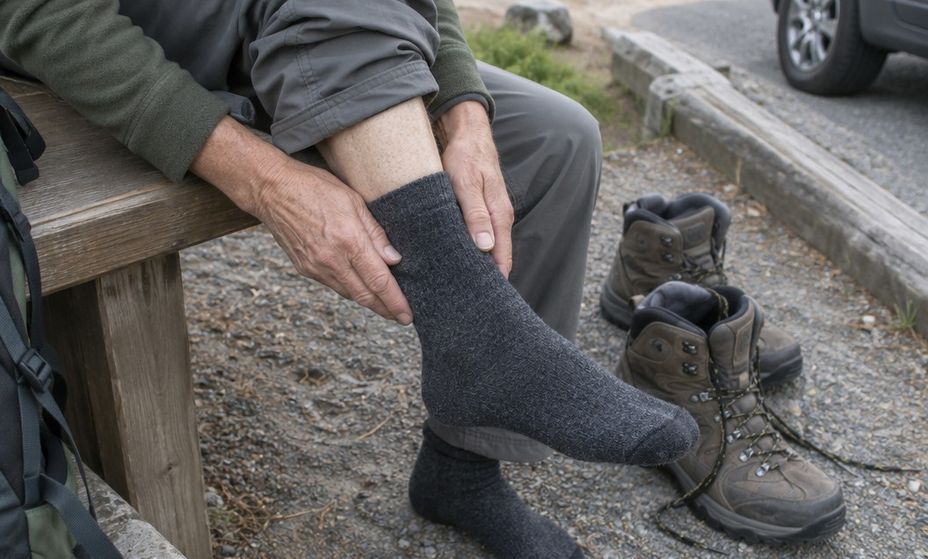
Darn Tough says the best test of whether socks are too tight is to wear them for a full day.
Flex your toes: if the sock moves with them, it fits. If the sock resists so strongly that you can’t flex them, it is too small.
Too big, the maker says, and the heel area rides up your Achilles. Too small, and the heel bed won’t be centered on your heel.
Darn Tough says your heel should sit squarely in the heel bed, and that if excess fabric is bunching, the sock is likely too big.