
If you walk most days, you already have a good base for hiking. The short answer: hiking is walking on a natural trail, where the ground is often uneven and the path may climb and drop.
As a rule of thumb, a park path is firm and mostly level, and a trail is not. Surface and slope are the two big changes; the walking itself stays the same.
You will also carry a little more, such as extra water.
Where a walk ends and a hike begins
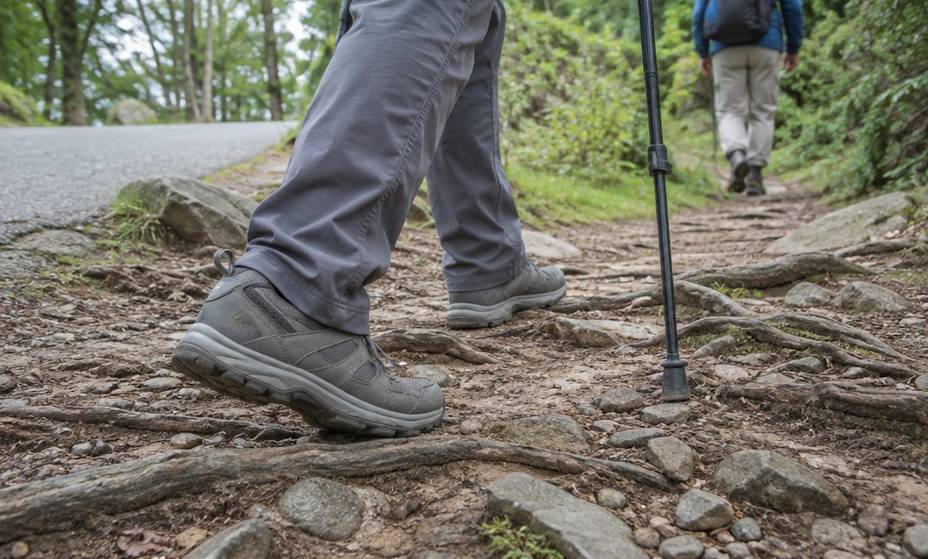
There is no sharp line between the two.
Dr. Aaron Baggish of Massachusetts General Hospital says hiking “exists along an entire continuum, from a gentle walk on a flat wooded path to mountain climbing.”
He was quoted by Harvard Health Publishing, the consumer health publisher of Harvard Medical School.
You can sit near the gentle end for as long as you like.
A simple way to tell where you are: a firm, level path is a walk. Dirt, rock and slopes make it a hike.
Walking and hiking side by side
The effort row uses MET values from the Compendium of Physical Activities, a research list of the energy cost of everyday activities.
A higher MET means the body works harder.
| Park path walk | Beginner hike | |
|---|---|---|
| Surface | Paved or firm | Natural and uneven |
| Elevation | Mostly level | Climbs and descents |
| Effort | MET 3.8: 2.8 to 3.4 mph, level, moderate pace, firm surface | MET 5.3: normal pace through fields and hillsides, no load |
| Gear | Everyday walking shoes | Footwear with traction and support, plus water |
Pace changes the picture. The Compendium lists hiking slowly through fields and hillsides, no load, at MET 3.8.
That equals a moderate walk on a level, firm path.
Slow, easy hiking over fields and hillsides costs about the same as moderate walking on the flat. Brisk level walking at 3.5 to 3.9 mph is higher, at MET 4.8.
What changes for your body
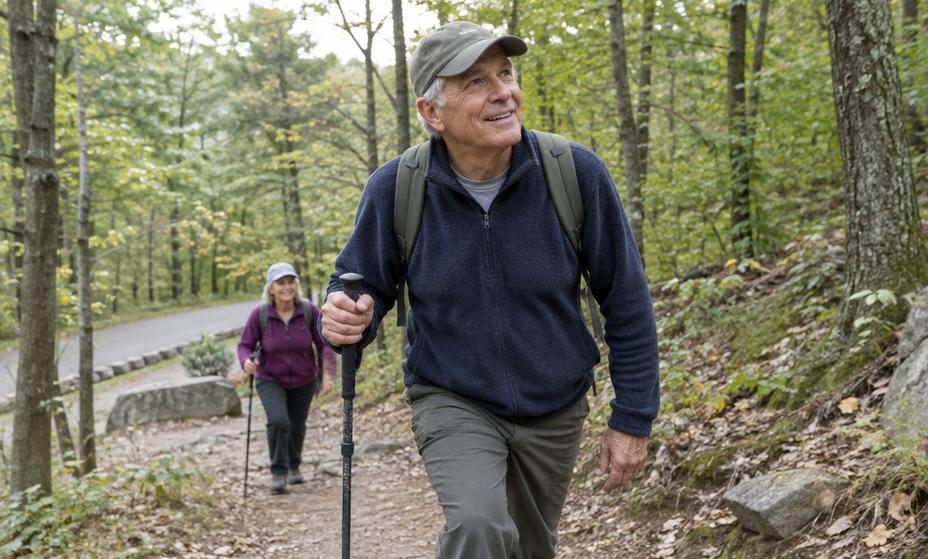
Harvard Health notes that a route with some gain in elevation forces your heart to work harder.
It adds that uphill works the hips and buttocks, while downhill builds the quadriceps (the large muscles at the front of the thigh).
Dr. Luke Apisa, an emergency medicine physician, told Harvard Health that going downhill can be jarring to the knees without extra support. Poles can give that support, he says.
According to Dr. Baggish, the slightly uneven surface of a trail is a natural way to engage the core muscles and hone balance skills.
Dr. Baggish says you usually don’t get that sideways motion on a treadmill or a bike.
The National Institute on Aging (NIA), the federal research agency on aging, gives weekly targets for older adults.
Its weekly targets:
- At least 150 minutes of moderate aerobic activity, such as brisk walking, built up gradually
- Muscle-strengthening on at least two days
- About three balance sessions
Trail walking adds aerobic work, works the leg muscles and challenges balance, but you do not need a trail to meet these targets.
This is general information, not medical advice. Talk to your doctor before you add climbs, especially if you have heart, joint or balance concerns.
Gear: what to add
The American Hiking Society, a national nonprofit for hikers and trails, puts footwear first on its list of ten essentials.
It asks you to think about traction, support and protection. Dr. Baggish adds well-fitting shoes with good ankle support, broken in on shorter walks so you don’t get blisters.
Water matters more on a trail. The society’s guideline is half a liter per hour in moderate temperatures and terrain.
It says to pack its essentials even for a hike of a couple of hours.
Start with water and well-fitting shoes with grip, then work through the rest of the society’s list.
Poles come next if you have problems with stability. Dr. Baggish says they give an added level of security on uneven terrain.
From park path to first trail
Here is a way to step up:
- Keep your daily walk as it is.
- Add easy nature walks for beginners, which are short and mostly level.
- Choose a first trail using a rating system, and read how to choose your first hiking trail.
- Bring water and a friend.
If you are over 60, read how to start hiking after 60 for medical clearance and building up gradually.
How to read a trail rating
Shenandoah National Park, in Virginia’s Blue Ridge Mountains, rates its own trails with a formula. It is the park’s own system.
Multiply elevation gain by 2 and by the distance in miles. The square root is the rating.
A 2-mile trail with 250 feet of gain works out to about 32. That falls in the park’s Easiest band.
The park describes Easiest as generally suitable for anyone who enjoys walking. It is mostly level or has a slight incline, generally under 3 miles.
If a park names an easiest band, start there.
The park calls its formula imperfect. Its pace of 1.5 miles per hour for easiest trails counts moving time only, with no rests.
That puts a 2-mile trail at roughly an hour and 20 minutes of walking, plus your breaks.
For your first trail, choose one in the easiest band, or a short, mostly level loop under 3 miles, and add time for breaks.