
If you have no roof rack and nowhere to keep a hard-shell kayak, an inflatable is the kind to look at. The Intex Explorer K2, a two-person kayak, is the first pick here.
Are inflatable kayaks good? For calm lakes and mild rivers, with a car trunk as the only storage, they can be. Open, windy water is where they struggle.
Links to Amazon on this page are affiliate links, so a purchase through one pays this site a small commission and costs you nothing extra.
| Where you'll use it | A sensible first pick |
|---|---|
| Calm lakes with a partner, the widest hull | Intex Explorer K2 |
| Two paddlers who want the most room | Sea Eagle 370 Pro |
| The narrowest hull, longer than the Explorer | Intex Challenger K2 |
Intex Explorer K2
A first inflatable for calm lakes, paddled with a partner
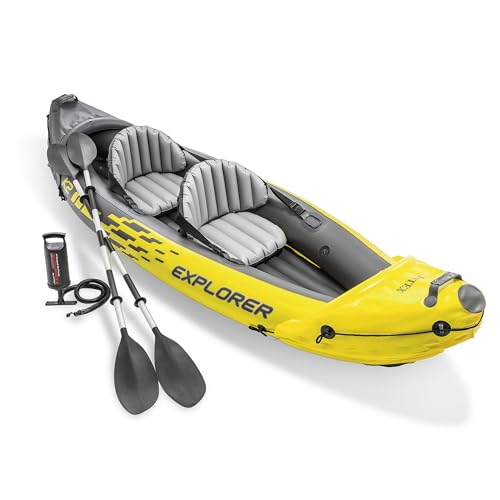 Intex Explorer K2 Inflatable Kayak, 2 Person
Inflatable I-beam floor
Two seats, two 86 in paddles and a pump included
Check stock and price on Amazon
Intex Explorer K2 Inflatable Kayak, 2 Person
Inflatable I-beam floor
Two seats, two 86 in paddles and a pump included
Check stock and price on Amazon
Intex, which makes pools, airbeds and inflatable boats, rates this kayak for two adults and 400 pounds. It sells the boat for “lakes and mild rivers.” Inflated, it measures 10 ft 3 in long by 3 ft wide.
At 3 feet, it’s the widest of the three picks.
The box holds two inflatable seats with backrests, two 86 inch paddles and a high-output pump.
A removable skeg (a small fin under the hull that helps it keep a straight line) is included. Intex puts a Boston valve (a quick-action air valve) on each side.
- Think twice if
- Open water or windy days
Sea Eagle 370 Pro
Two paddlers who want the most room
 Sea Eagle 370 Pro Inflatable Kayak, Pro Package
I-beam floor and two skegs
Two deluxe seats and two 4-part paddles
Check stock and price on Amazon
Sea Eagle 370 Pro Inflatable Kayak, Pro Package
I-beam floor and two skegs
Two deluxe seats and two 4-part paddles
Check stock and price on Amazon
Sea Eagle, a family-owned inflatable boat maker dating to 1968, rates this SE370 model for three people or 650 pounds. It adds that the boat is “best-suited space-wise to accommodate two persons.”
Inflated, it’s 12 ft 6 in long and 2 ft 9 in wide. Sea Eagle gives 32 pounds in its description and 33 in its spec table.
It says the boat sets up in “less than 10 minutes.” The Pro package adds two deluxe seats, two 4-part paddles, a pump and a repair kit, with a three-year warranty against manufacturing defects.
The SE370 is rated “suitable up to Class III,” an intermediate whitewater grade, but this page is about calm water. Sea Eagle’s own manual says beginners shouldn’t attempt Class III rapids.
- Suits you if
- A longer hull with a stated setup time and warranty
Intex Challenger K2
A longer, narrower hull than the Explorer
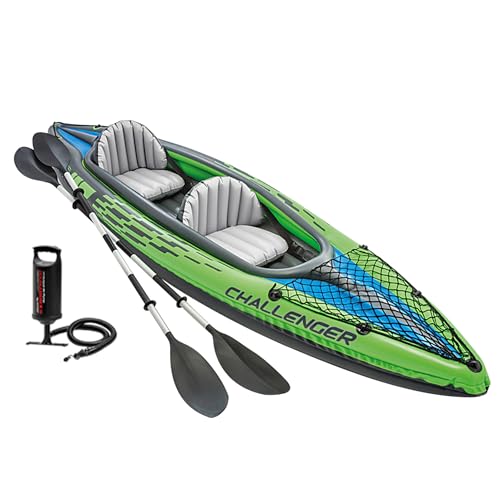 Intex Challenger K2 Inflatable Kayak, 2 Person
Low-profile deck and cockpit
Removable skeg, folds into a carry bag
Check stock and price on Amazon
Intex Challenger K2 Inflatable Kayak, 2 Person
Low-profile deck and cockpit
Removable skeg, folds into a carry bag
Check stock and price on Amazon
Intex rates the Challenger K2 for two adults and 400 pounds. Inflated, it’s 11 ft 6 in long and 2 ft 6 in wide.
At 2 ft 6 in, it’s the narrowest of the three, and its length is more than the Explorer’s 10 ft 3 in.
Intex describes a low-profile deck and a cockpit “designed for comfort and space,” so you sit inside the hull. The listing mentions removable, adjustable seats.
The boat folds into a carry bag, and Intex says its Boston valve lets it inflate and deflate “in minutes.” Its page lists two 86 inch aluminum paddles and a high-output pump.
- Think twice if
- Anyone who wants the widest hull
What an inflatable does well, and where it falls short
Good for:
- Storage and transport. Sea Eagle says the SE370 “packs down small enough to fit in the smallest car trunk.” The Challenger K2 folds into a carry bag.
- Quick setup. Sea Eagle gives under 10 minutes for the SE370, and Intex says the Challenger K2 inflates in minutes.
- Calm lakes and mild rivers. Intex sells both K2 models for that water.
- Stability, per one maker. Sea Eagle says its boats are “quite stable compared to aluminum or wooden canoes and kayaks because of their large tubes.”
Not for:
- Open or windy water. The park advice below explains why.
- Rough ground. Sea Eagle’s manual says not to drag the boat over rocks or gravel if it can be avoided.
- Beginner whitewater. The SE370 is rated up to Class III, which Sea Eagle’s manual says beginners shouldn’t attempt.
- Storing it damp. Sea Eagle says the boat must be dry before it’s put away.
One person or two
All three are rated for two adults. Sea Eagle rates the SE370 for three people but says two adults fit most easily.
Intex calls the Challenger K2 great for lakes and mild rivers “solo,” and the Explorer K2 great “with a friend.” The Intex pair top out at 400 pounds, against 650 for the SE370.
Sea Eagle’s manual says that when two people paddle together, they should coordinate their strokes so both paddle in unison.
Carrying and setting up
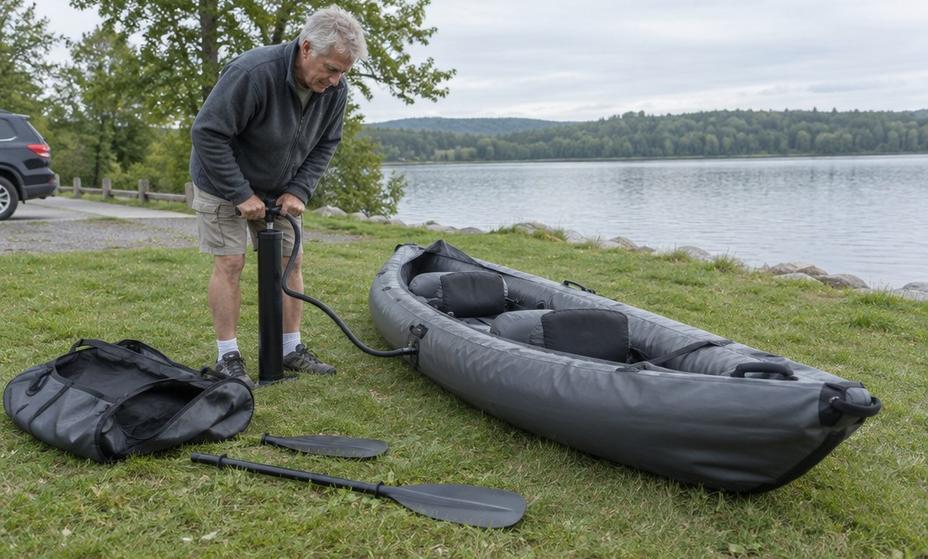
Sea Eagle gives the SE370’s boat weight: 32 to 33 pounds, depending on which of its pages you read. Intex’s pages list about 36 to 37 pounds for each K2 without saying whether that’s the boat or the box.
Sea Eagle lists inflation at 8 minutes. Its manual says not to drag the boat over rocks or gravel if it can be avoided.
Wind and calm water
The National Park Service is the federal agency that has cared for US national parks since 1916. It says short recreational kayaks are “prone to being pushed around in the wind and waves.”
At Apostle Islands National Lakeshore, it advises against using them on windy days or on big open water such as Lake Superior. That advice covers recreational kayaks in general, and all three picks fall in that size class.
Sleeping Bear Dunes National Lakeshore adds that they’re designed for inland waters.
Wear a life jacket on any water. The US Coast Guard, whose Boating Safety Division works to cut boating deaths and injuries, recommends wearing it at all times underway.
Federal law requires one wearable, Coast Guard-approved life jacket for each person on board, and boating rules apply to kayaks.
Rent first, then buy
The American Canoe Association, a national paddling education nonprofit founded in 1880, publishes a beginner’s guide covering canoes, sea kayaks and inflatables. It says “Rent before you buy.”
The guide adds that you should rent often and try as many different boats as you can. People come in different sizes, shapes and abilities, it says.
The association also offers Smart Start, a free online safe-paddling course made with the Coast Guard.
When an inflatable isn’t the answer
If you have a roof rack and room to store a hard-shell kayak, an inflatable has less to offer you. Its case here is storage and transport.
Skip it if you expect open, windy water or whitewater. If you haven’t decided between sit-on-top and sit-inside kayaks, keep renting. That page also covers renting before you buy.
If balance worries you, kayak stability and balance is worth reading before you choose.
In cooler months, check the water temperature, not just the air, before you choose a day to go.
Before the bag goes back in the trunk
Dry the kayak and its accessories fully before you pack them away. Sea Eagle’s manual gives the reason: moisture can cause mildew. Its FAQ adds that mold leaves a stain that can’t be removed.
Sea Eagle says the best way to store its boats is folded, in the bag, in a clean, dry space. Before yours goes in, dry it completely, whether it’s being put away for the night or the season.