
“Leaves of three, let it be” is good advice, and it only gets you halfway.
The rhyme gets one thing right. Poison ivy leaves come in groups of three leaflets, so any three-leaflet plant deserves a second look.
What the rhyme misses is that plenty of harmless plants also have three leaflets. Followed literally, it would have you avoiding plants that are harmless, and it still wouldn’t tell you which one is the problem.
Three leaflets plus a few more clues is what makes the call.
The leaf clues that separate it from look-alikes
University of Maryland Extension is the University of Maryland’s outreach service for farming, gardening and natural resources. It says each poison ivy leaf is made of three leaflets.
Two details narrow it down:
- The middle leaflet sits on a longer stem than the two side leaflets. The side stems can be almost invisible.
- The leaves are alternate, which means they attach one at a time along the vine, never in directly opposite pairs.
Young leaves can look shiny. Edges vary too.
Illinois Extension is the University of Illinois’ public outreach and education service. It notes that some leaves carry blunt teeth or a single rounded lobe like a mitten.
Don’t rely on a smooth edge or a glossy surface. Leaf edges can be smooth, bluntly toothed or mitten-shaped.
Ground cover, shrub or vine
Poison ivy doesn’t grow in one shape. Illinois Extension describes it as a small shrub up to 3 or 4 feet tall, or a climbing vine.
Illinois Extension says it spreads readily and forms patches in partly shaded woodland.
In its low form, it looks like a carpet of three-leaflet leaves under the trees.
You can pick up the oil without ever reaching for a leaf. A walker brushing past a knee-high patch can carry it home on pants and shoe laces.
The hairy vine on the tree
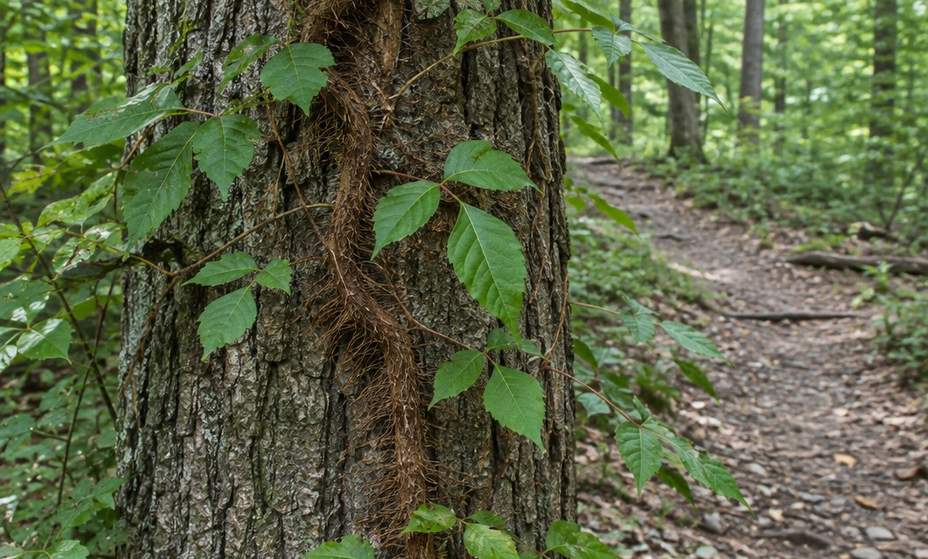
Older poison ivy climbs trees on thick, hairy vines. Maryland Extension notes that younger vines don’t have the hairs.
Older vines are hairy and younger ones aren’t, so hair alone doesn’t name the plant.
A hairy vine with three-leaflet leaves is the one to avoid.
The vine itself carries the oil. Illinois Extension says the woody stems of poison ivy hold higher levels of urushiol, the plant’s rash-causing oil, than the leaves do. That means a bare vine in winter still counts.
Keep your hands off any hairy vine you can’t name, on a fence or a trunk.
How it changes through the seasons
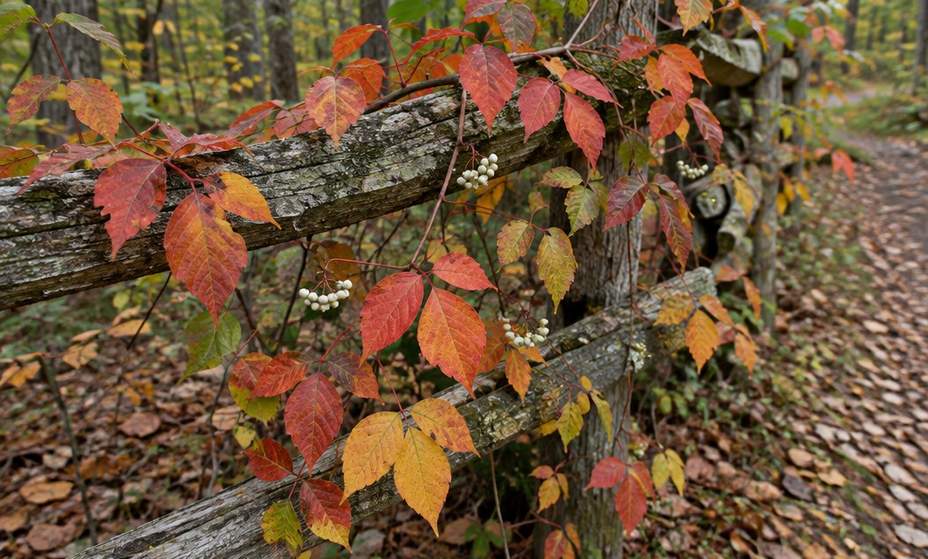
The plant is the same all year, but it doesn’t look the same. This table shows what to scan for.
| Season | What you’ll see | Watch for |
|---|---|---|
| Spring | New leaves, which can be shiny, on a plant just leafing out | Easy to miss among other new growth |
| Summer | Full three-leaflet leaves on shrub, ground patch or vine | The longer middle stem and alternate leaves |
| Fall | Leaves turning yellow or red | Still capable of causing a rash |
| Winter | Bare stems, and hairy vines on trunks | The vine still holds the oil |
Maryland Extension says the leaves turn yellow or red in the fall and can still cause a rash.
The Illinois page adds that bare twigs are reddish to orangish brown, with no leaves left to count. In winter, look for hairy vines on trunks and reddish to orangish-brown twigs.
Look-alikes that waste your worry
Three common look-alikes:
- Virginia creeper usually has five leaflets, not three. Count them.
- Boxelder seedlings do have three leaflets, but the leaves grow in opposite pairs, not alternate.
- Raspberry and blackberry canes have prickles on the stems. According to Maryland Extension, poison ivy never has them.
If you can find a prickle, an opposite pair of leaves along the stem or a fifth leaflet, it isn’t poison ivy.
Poison oak and sumac, briefly
Poison oak and poison sumac are cousins of poison ivy.
The American Academy of Dermatology, the professional association for US dermatologists, says poison ivy and poison oak grow in every state except Alaska and Hawaii.
The oil from these plants is what causes the rash. This page sticks to poison ivy.
If you touch it, what to do next
The American Academy of Dermatology says the oil can stay on surfaces for months or years until it’s washed off. That includes boots, laces and tools, and the oil can also stick to a dog’s coat.
Washing is what ends the exposure, and the oil doesn’t wash itself off. The Academy’s advice after contact:
- Take a warm shower and wash gently
- Rinse well, and wash under your nails
- Machine-wash the clothes you wore in hot water and detergent as soon as you get home
- Bathe pets, because the oil can stick to their fur
This is general information, not medical advice. A severe reaction or any trouble breathing means seeing a doctor.
The other habit worth building is tick checks after walks in grass and brush.
Long pants and closed shoes make a brush with a patch easier to manage. For layers, fabrics and footwear by season, see what to wear hiking in different weather.
When you get home, take your shoes off outside and put your clothes straight into the washer on hot with detergent. Wash your dog next, then shower and rinse well, including under your nails.