
The clearest result in the forest bathing reviews is a small drop in blood pressure. A 2017 review of 20 trials found systolic pressure (the top number) about 3 points lower after time in a forest than after time elsewhere.
The trials were short and the groups were small, and another 2017 review rated every one of its studies at high risk of bias.
Forest bathing is a pleasant, low-cost way to spend 20 minutes outdoors, and the early research points in a good direction.
It isn’t a proven treatment for anything.
What forest bathing actually is
Forest bathing is slow, quiet time among trees, with your attention on what you can see, hear, smell and feel. There’s no destination, no distance goal and no pace to hold.
The term comes from Japan.
Authors of a 2017 review in Environmental Health and Preventive Medicine (a peer-reviewed medical journal) say so. They write that “it was the Japanese who coined the term ‘shinrin-yoku'” for recreation and relaxation in a forest.
The word is often translated as forest bathing. The “bathing” means soaking in the surroundings, not getting wet.
Nothing here needs special gear. A park with mature trees is a fine place to practice.
What the research shows
Two reviews are worth knowing. They are different kinds of study.
Ideno and colleagues, writing in BMC Complementary and Alternative Medicine (a peer-reviewed medical journal), pooled the results of 20 trials in a meta-analysis. Oh and colleagues reviewed six trials without pooling them.
Blood pressure is the best-supported result, and it’s small. The Ideno team’s 20 trials had 732 participants. Systolic pressure was 3.15 mmHg lower in the forest settings than in non-forest settings.
Diastolic pressure, the bottom number, was 1.75 mmHg lower across 17 trials.
Those are average differences between settings, mostly measured on the day. They aren’t a promise about any one person. The authors list limits of their own:
- Most trials measured only immediate effects, and only two ran longer than one day.
- In one trial, blood pressure eight weeks after a 3-day program no longer differed from the control group.
- The review did not account for blood pressure medication.
The wider health claims are weaker.
The second review appeared in Environmental Health and Preventive Medicine. It looked at six randomized trials covering outcomes such as stress, mood, immune function and inflammation.
The authors concluded that “the lack of high-quality studies limits the strength of results.”
- Every study carried a high risk of bias.
- Half the trials had small samples, and five of the six had no long-term follow-up.
- Participants in these trials knew whether they were in a forest or a city.
None of this proves cause. The reviews compare settings. They can’t say which part of the setting, if any, produces the difference.
The evidence supports a modest effect, and no more.
Your first 20-minute session
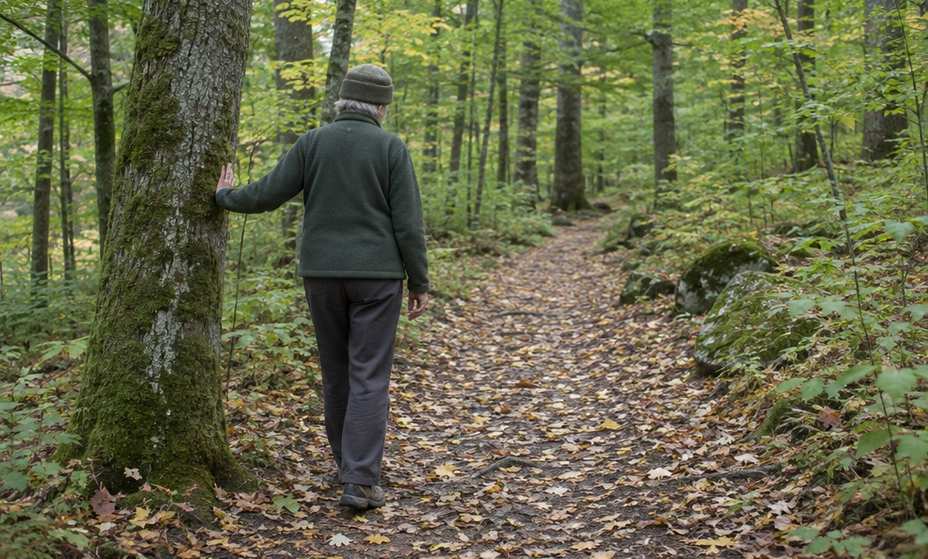
Pick a flat, well-marked trail or a park path you can leave easily. If you’re newer to walking outdoors, an easy nature walk for beginners is the right setting. Tell someone where you’ll be, and carry water.
- Minutes 0 to 3: Put the phone away. Silence it and zip it into a pocket. Check it only if you need it for safety.
- Minutes 3 to 8: Walk slower than feels natural. Aim for a pace where you could stop mid-step without wobbling. Cover as little ground as you like.
- Minutes 8 to 10: Pick a sit-spot. A bench, a log or a flat rock works. Choose one with a stable seat and a back or arm support if you want one.
- Minutes 10 to 17: Use one sense at a time. Spend a minute or two on each, as listed below.
- Minutes 17 to 20: Finish slowly. Take three unhurried breaths, look around once more, then stand and walk back at the same easy pace.
Everything else is optional. If you get restless at minute eight, that’s normal. Notice it and carry on.
Working through the senses
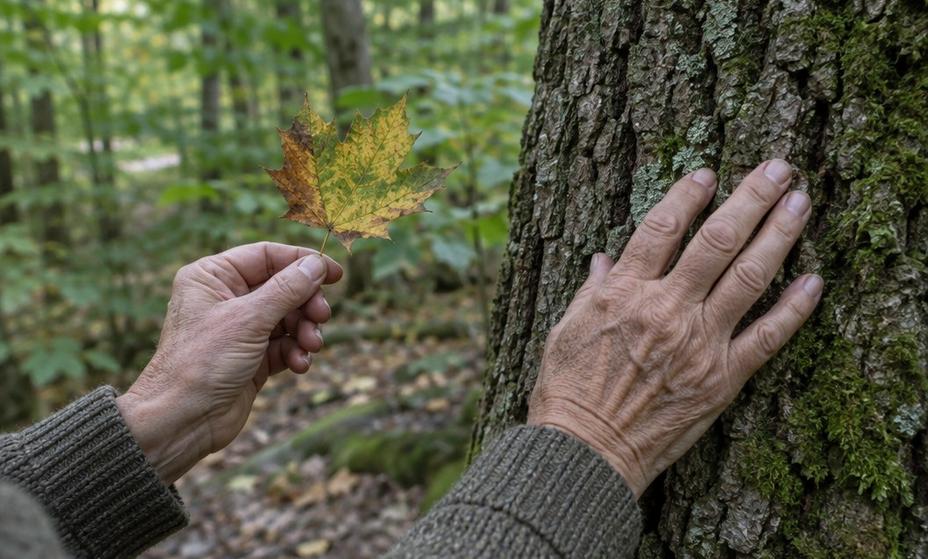
Taking the senses one at a time gives the mind one thing to do. It also gives a first session a clear shape.
- Sight: Pick one tree and follow it from roots to crown. Notice the greens.
- Sound: Listen for the farthest sound first, then the nearest. Wind, birds and your own breathing all count.
- Smell: Crush a fallen leaf or needle gently between your fingers and smell it.
- Touch: Rest a hand on bark or moss. Feel whether it’s rough, damp or warm.
- Taste: Skip this one. Don’t eat anything you find.
You aren’t trying to feel anything in particular. If you don’t, the session still counted as 20 minutes outside.
Who should check first
This is general information, not medical advice. A forest walk is not a substitute for treatment, and the studies above don’t suggest otherwise.
If you have a heart condition or high blood pressure, keep taking your medication and follow your doctor’s plan. Ask your doctor about activity that suits you. Anyone who feels dizzy, short of breath or unsteady should stop and sit.
For what regular trail walking does for body and mind, see the health benefits of hiking. For time outside and stress in older adults, see time outdoors for stress and wellbeing.
Plan your next session for the same time next week, and keep it to 20 minutes.