
Ice on a sidewalk and ice on a trail need different traction. For flat, icy pavement, start with Yaktrax Walk. For packed snow and icy trails, start with Kahtoola MICROspikes.
Links to Amazon on this page are affiliate links, so a purchase through one pays this site a small commission and costs you nothing extra.
| Where you'll use it | A sensible first pick |
|---|---|
| Icy trails and packed snow | Kahtoola MICROspikes |
| Mixed ground, from trail to icy road | Kahtoola EXOspikes |
| Hard-packed snow and ice on city streets | Kahtoola NANOspikes |
| Icy sidewalks, driveways and flat paths | Yaktrax Walk |
Kahtoola MICROspikes
Packed snow and icy trails, in hiking shoes or boots
 Kahtoola MICROspikes traction (Medium)
12 stainless steel spikes per foot
Welded chains and a stretchy elastomer harness
Check stock and price on Amazon
Kahtoola MICROspikes traction (Medium)
12 stainless steel spikes per foot
Welded chains and a stretchy elastomer harness
Check stock and price on Amazon
These are the chain-and-spike type. Kahtoola lists the longest spikes of its three models here, 0.41 inches (10.4 mm). It calls them a “dependable workhorse in steep, icy terrain.”
The welded chains, Kahtoola says, shed snow buildup, and the harness stays stretchy down to -22°F.
They’re sold by size, so pick yours from the sizing chart on the listing.
- Think twice if
- Walks that never leave the sidewalk
Kahtoola EXOspikes
Routes that mix trail, packed snow and icy road in one walk
 Kahtoola EXOspikes traction (Medium)
12 spikes per foot with tungsten carbide tips
TPU lugs and an open design that sheds snow
Check stock and price on Amazon
Kahtoola EXOspikes traction (Medium)
12 spikes per foot with tungsten carbide tips
TPU lugs and an open design that sheds snow
Check stock and price on Amazon
Kahtoola describes these as an “adaptable road to trail grip.” The spikes are 0.29 inches (7.4 mm), shorter than the MICROspikes. The pair weighs 6.6 to 8.1 ounces depending on size.
Choose them over the MICROspikes if your route crosses plowed or icy pavement as often as it crosses a trail.
Sizes vary here too, so check the chart on the listing.
- Suits you if
- One pair when your walk changes ground partway through
Kahtoola NANOspikes
City streets and sidewalks with hard-packed snow and ice
 Kahtoola NANOspikes traction (Medium)
10 tungsten carbide studs per foot
Low profile, heel tab for removal
Check stock and price on Amazon
Kahtoola NANOspikes traction (Medium)
10 tungsten carbide studs per foot
Low profile, heel tab for removal
Check stock and price on Amazon
Kahtoola calls this “low-profile traction for hard, icy surfaces” and points it at city streets and sidewalks. The studs are only 0.21 inches (5.3 mm) long.
That low profile suits walking shoes and lighter footwear. The listing mentions a redesigned heel tab that makes the harness easier to stretch on and off.
Sizes run from women’s 5 to men’s 13 and up, so choose yours on the listing.
- Think twice if
- Trails or deep snow
Yaktrax Walk
Icy sidewalks, driveways and flat paths near home
 Yaktrax Walk traction cleats
Steel coils for 360-degree grip
Slip-on rubber sling with heel tab
Check stock and price on Amazon
Yaktrax Walk traction cleats
Steel coils for 360-degree grip
Slip-on rubber sling with heel tab
Check stock and price on Amazon
This is the coil type: 1.2 mm zinc-coated steel coils held in a thermoplastic rubber sling that stretches over your shoe.
The maker says the coils grip going forward, backward or sideways, and that they have no sharp edges to damage surfaces.
The heel tab is how you pull them on and off. There are no straps or buckles, just the slip-on sling.
- Suits you if
- A slip-on coil cleat for ordinary shoes
Which ground gets which kind
Coil cleats wrap the sole in steel coils and work on flat, icy surfaces. Chain-and-spike types add points that bite into packed snow and ice on rougher ground.
The American Hiking Society, a national nonprofit for hikers, says “micro-spikes and other traction devices provide additional traction” on packed snow and ice.
Match the kind to the surface under your feet: coils for flat pavement, spikes once the path turns to packed snow or trail.
| Your ground | Kind | Picks |
|---|---|---|
| Icy sidewalk, driveway, flat path | Coil cleat | Yaktrax Walk |
| Hard-packed snow and ice on city streets | Studded | Kahtoola NANOspikes |
| Trail and icy road in one walk | Chain and spike | Kahtoola EXOspikes |
| Packed snow and icy trail | Chain and spike | Kahtoola MICROspikes |
This page covers ordinary shoes and hiking shoes. Crampons and mountaineering gear are a different category and not covered here.
Sizing them over your shoes
Put the shoes you actually walk in next to the sizing chart, not your everyday dress shoes. Every one of these stretches over the shoe, so the shoe decides the size.
- Kahtoola listings are sold by size. The links above go to the Medium listing, and the Amazon page lets you switch sizes against Kahtoola’s chart.
- MICROspikes: the listing calls them ideal for hiking shoes and boots. Size them against the boots or shoes you’ll wear them on.
- EXOspikes: the listing says the open design adapts to many kinds of flexible footwear.
- NANOspikes: aimed at lighter footwear, with a listed size range from women’s 5 to men’s 13 and up.
- Yaktrax Walk: an elastic sling made to fit a variety of footwear, per the listing.
Pull them on once at home, standing next to a chair or counter, before the first icy day.
Taking them off indoors
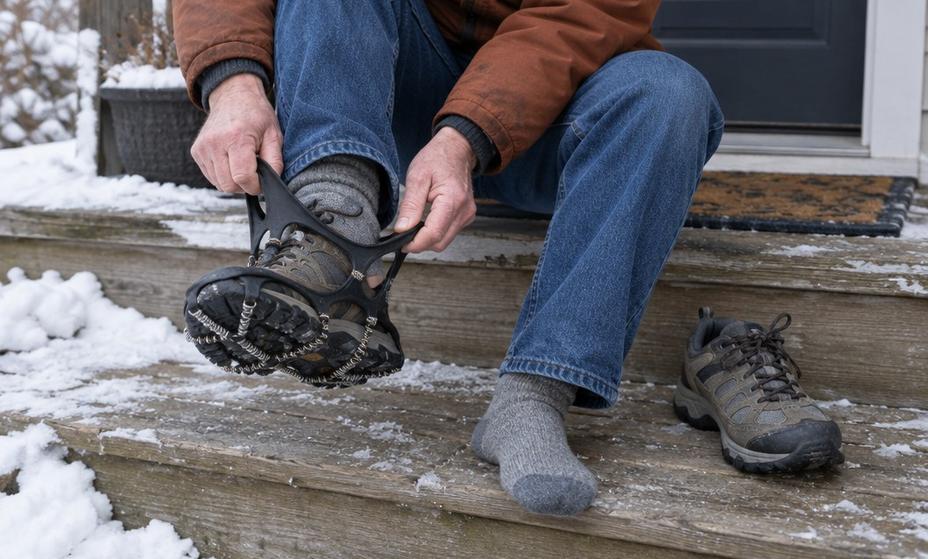
Steel and carbide points on tile, hardwood or a store floor have nothing to bite into. A smooth floor with metal underfoot is not where you want to be standing on one leg.
Take them off at the door, and sit down to do it. A step, bench or chair works.
Hook your thumb under the heel tab where there is one, or peel the harness back from the heel. Then pull straight off the shoe.
Wipe the points dry afterward. Stairs deserve the same rule: no cleats on indoor stairs, ever.
When you don’t need to buy any
Skip them if your daily route is reliably cleared and salted down to bare pavement. A shoe with a good rubber sole is usually enough there.
If the snow is deep, traction under the shoe doesn’t help you stay on top. The American Hiking Society says “snowshoes reduce how much a hiker sinks into the powder,” and that is the right tool for deep snow.
And on a glaze-ice day, staying in is a fair choice. Cleats improve your grip on ice but don’t make a fall impossible. Slow down and shorten your steps.
This isn’t medical advice. If balance or falls worry you, talk to your doctor before walking outside on ice.
Which pair to keep by the door
If you stay on sidewalks and driveways, Yaktrax Walk is the simple answer.
If you walk packed snow or icy trails, check the Kahtoola MICROspikes pick first.
What changes for an older body in the cold is covered in hiking in cold weather after 50. That includes wind chill and when to turn back.
If a slip has you thinking about footing in general, preventing falls on the trail covers balance training after 60.
Hang the pair on a hook right by the front door, or leave them in the trunk of the car. Then they’re within reach before you step out onto ice.