
The four first-pair binoculars below weigh from 18 to 23.8 ounces. The Celestron Nature DX 8×32 is the one to start with, because at 18 ounces (510 g) it is the lightest of the four.
Some links here lead to Amazon. If you buy through one, this site earns a small commission at no extra cost to you.
| Where you'll use it | A sensible first pick |
|---|---|
| Lightest pair, long walks | Celestron Nature DX 8×32 |
| Long eye relief, light for a full-size 8×42 | Nikon PROSTAFF P3 8×42 |
| ED glass and dielectric prism coatings | Nikon MONARCH M5 8×42 |
| Birds that land a few steps from the path | Vortex Crossfire HD 8×42 |
Celestron Nature DX 8×32
Easy flat loops and park paths where you carry them for hours
 Celestron Nature DX 8×32 Binoculars
18 oz (510 g), roof prism, waterproof
Eye relief 17.5 mm, close focus 6.5 ft
Check stock and price on Amazon
Celestron Nature DX 8×32 Binoculars
18 oz (510 g), roof prism, waterproof
Eye relief 17.5 mm, close focus 6.5 ft
Check stock and price on Amazon
Celestron lists 18 ounces, which is 2.3 ounces lighter than the next pair here. The 32 mm lenses are smaller than the 42 mm ones on the other three.
Celestron describes them as a balance of portability and brightness. It also lists phase-coated Bak-4 prisms, a waterproof, nitrogen-filled body and a limited lifetime warranty.
Compare the Nature DX 8×32 on Amazon.
- Suits you if
- The lightest of the four, with a 6.5 ft close focus
Nikon PROSTAFF P3 8×42
Walks where you wear glasses and want a full-size 8×42 that stays under 21 ounces
 Nikon PROSTAFF P3 8×42 Binoculars
20.3 oz (575 g), roof prism
Eye relief 20.2 mm, close focus 9.8 ft
Check stock and price on Amazon
Nikon PROSTAFF P3 8×42 Binoculars
20.3 oz (575 g), roof prism
Eye relief 20.2 mm, close focus 9.8 ft
Check stock and price on Amazon
Nikon lists an eye relief of 20.2 mm, the longest of the four.
That is the number to look at if you wear glasses. At 20.3 ounces it is the lightest of the three 8×42 pairs, so you get the larger lenses without the heaviest body.
Its weak point is close focus: at 9.8 feet it asks the most distance before a near bird comes into focus.
Compare the PROSTAFF P3 8×42 on Amazon.
- Think twice if
- Birds that land closer than 9.8 ft, which is the longest close focus of the four
Nikon MONARCH M5 8×42
Walks where you want ED glass and weight is not your first concern
 Nikon MONARCH M5 8×42 Binoculars
22.2 oz (629.3 g), ED glass, roof prism
Eye relief 19.5 mm, close focus 8.2 ft
Check stock and price on Amazon
Nikon MONARCH M5 8×42 Binoculars
22.2 oz (629.3 g), ED glass, roof prism
Eye relief 19.5 mm, close focus 8.2 ft
Check stock and price on Amazon
Nikon’s page lists extra-low dispersion (ED) glass, which Nikon says reduces color fringing. It also lists a 19.5 mm eye relief that suits glasses.
It weighs 22.2 ounces, 1.9 ounces more than the P3, so what you gain is the glass, not lightness. If weight on the neck is your main worry, the first two picks come in lower.
Compare the MONARCH M5 8×42 on Amazon.
- Suits you if
- The only pick here with ED glass
Vortex Crossfire HD 8×42
Flower borders and feeders where birds sit just a few steps away
 Vortex Crossfire HD 8×42 Binoculars
23.8 oz, roof prism, VIP lifetime warranty
Eye relief 17 mm, close focus 6 ft
Check stock and price on Amazon
Vortex Crossfire HD 8×42 Binoculars
23.8 oz, roof prism, VIP lifetime warranty
Eye relief 17 mm, close focus 6 ft
Check stock and price on Amazon
Vortex lists a close focus of 6 feet, the shortest distance of the four. A bird on a fence about 6 feet away can still come into focus.
At 23.8 ounces it is the heaviest here, about 5.8 ounces more than the Celestron. Vortex backs it with its VIP unlimited lifetime warranty, which the maker describes as unconditional.
Compare the Crossfire HD 8×42 on Amazon.
- Suits you if
- A 6 ft close focus, the closest of the four
What 8×32 and 8×42 mean, and why weight matters on a walk
The National Audubon Society, a US bird conservation nonprofit, explains the two numbers. The first is the magnification and the second is the front lens diameter in millimeters.
It recommends six, seven or eight times, because hand movements are magnified along with the bird.
Audubon also says objectives larger than 42 millimeters are too big and heavy for most people to carry all day. That is why every pick here stops at 42 mm.
| Number | What it is | On a walk |
|---|---|---|
| 8x | Birds appear 8 times closer | Low enough that a steady hand holds the image |
| 32 vs 42 mm | Front lens width | 32 mm is smaller and lighter, 42 mm is larger and heavier |
| Weight | 18 oz to 23.8 oz here | About 1.1 to 1.5 lb |
| Eye relief | 17 mm to 20.2 mm here | How far your eye can sit back, which matters with glasses |
| Close focus | 6 ft to 9.8 ft here | The nearest bird you can bring into focus |
Here are the four side by side, lightest first:
| Pick | Weight | Eye relief / close focus |
|---|---|---|
| Celestron Nature DX 8×32 | 18 oz | 17.5 mm / 6.5 ft |
| Nikon PROSTAFF P3 8×42 | 20.3 oz | 20.2 mm / 9.8 ft |
| Nikon MONARCH M5 8×42 | 22.2 oz | 19.5 mm / 8.2 ft |
| Vortex Crossfire HD 8×42 | 23.8 oz | 17 mm / 6 ft |
The gap between lightest and heaviest is 5.8 ounces.
A harness that spreads the load across the shoulders is worth adding to the other three. The Vortex comes with one in the box.
Wearing glasses: eyecups down, eye relief up
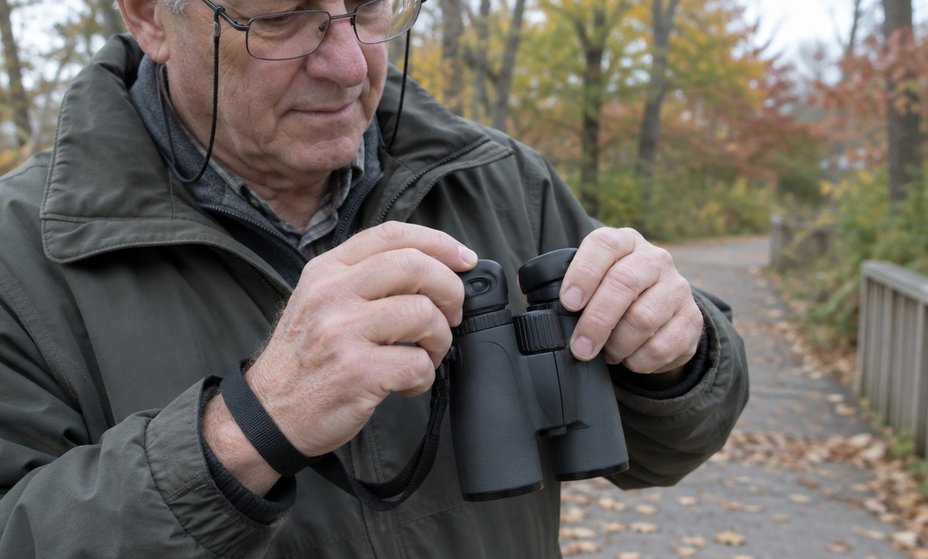
Eye relief is the distance between the eyepiece and your eye at which you still see the whole view. Glasses hold your eye farther back, so you need more of it.
Audubon says binoculars designed for birders offer 15 to 20 millimeters of eye relief and eyecups that extend and retract.
Three of the four picks fall inside that range, and the Nikon P3 sits just above it at 20.2 mm.
The Vortex at 17 mm and the Celestron at 17.5 mm are the shortest, though both are still inside it.
Twist or slide the eyecups down before you raise the binoculars. Press them to your lenses and look for a full, round view with no dark edges.
When to wait before buying
You may not need a new pair yet. An older pair may be enough for a first season if it is 8×32 or 8×42 with one center focus knob.
Borrow a pair on a guided bird walk, or from a friend, and notice which weight and which close focus feel right in your hands.
If you wear glasses, try the eyecups before you decide, because that fit is hard to judge from a number alone.
Start light, then try them on a familiar walk
For a first pair that does not weigh on your neck, the Celestron Nature DX 8×32 is the starting point.
If you wear glasses and want the larger 42 mm lenses, the Nikon P3 gives the longest eye relief at the lightest 8×42 weight.
For birds that land close, the Vortex has the shortest close focus. The Nikon M5 is the pick that adds ED glass.
Whichever you choose, wear them first on a walk you already know. That way your attention goes to the birds rather than the trail.
Once you are comfortable, read more on bird watching while hiking for what to look for along the way.