
Standard hiking and bird watching don’t mix well by default.
Your pace is the problem.
Your hands are full, you’re moving too fast, and you’re walking past most of the action. The trick isn’t expensive gear or overnight expertise. It’s a few adjustments that change what you notice.
Once you know where to look and what to listen for, you’ll spot species you’ve walked past dozens of times.
Start With a Field Guide You’ll Actually Carry
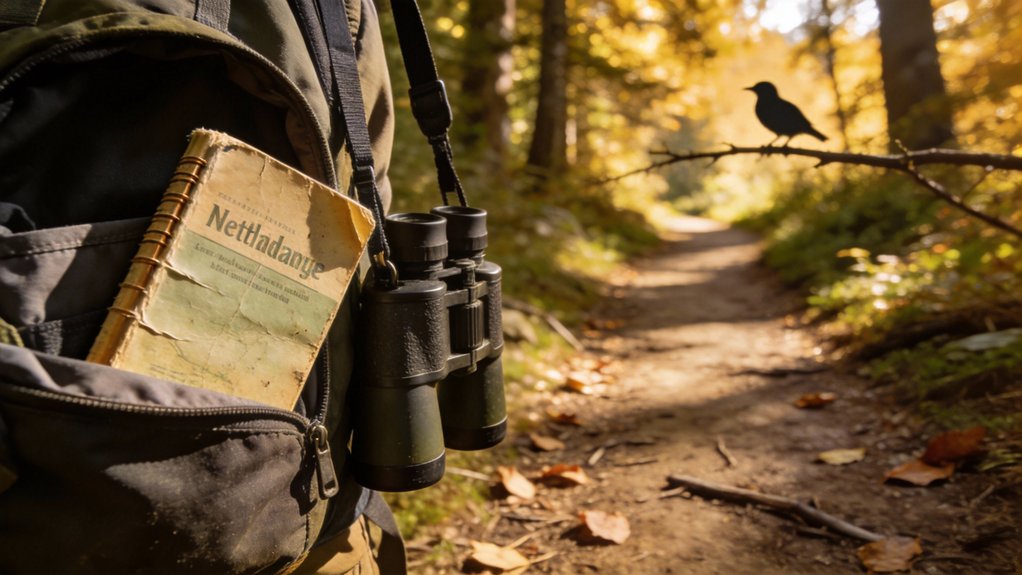
The starting point is one simple choice: pick a field guide you’ll genuinely use.
Compact, lightweight guides fit in a backpack or pocket and make it easy to check a bird on the spot. Look for color-coded illustrations or photos that help with quick identification in the field.
Digital apps skip the weight entirely. Merlin Bird ID offers real-time identification on your phone with no extra bulk.
Whatever format you choose, pick a guide covering your specific region. Concise details on size, migration patterns, and habitat make it practical to use mid-hike.
Pick Binoculars That Won’t Tire Your Neck
Since you’ll be looking through binoculars for hours, weight matters more than most beginners expect. Models under 1.5 pounds prevent the neck fatigue that cuts a walk short.
Look for padded neck straps or harness systems that spread the load across your shoulders rather than concentrating it at the back of your neck.
A wide field of view makes a real difference. At least 300 feet at 1,000 yards lets you locate birds without constantly swiveling. Adjustable eyecups and a comfortable grip matter too.
Waterproof and fog-proof construction handles whatever weather you meet on the trail. If you’re starting without a pair, you can compare lightweight binoculars on Amazon to find a comfortable weight for longer walks.
Where this page links to kit on Amazon, those are affiliate links. A purchase made through one earns this site a small commission at no additional cost.
Embrace Slower Hiking to Spot More Birds
Slowing down transforms what you notice.
Half speed. Twice the birds.
A simple routine helps:
- Walk at about half your normal speed to pick up sounds and slight movements
- Stop every 10-15 minutes to scan and listen
- Seek out wetlands or wooded sections where birds concentrate
- Use an identification app during quiet pauses to confirm what you’ve found
The birds don’t come to you; you go to their pace.
A quiet companion doubles the eyes and ears, and hiking with others adds a safety margin on longer trails too.
Move Quietly and Listen for Bird Calls
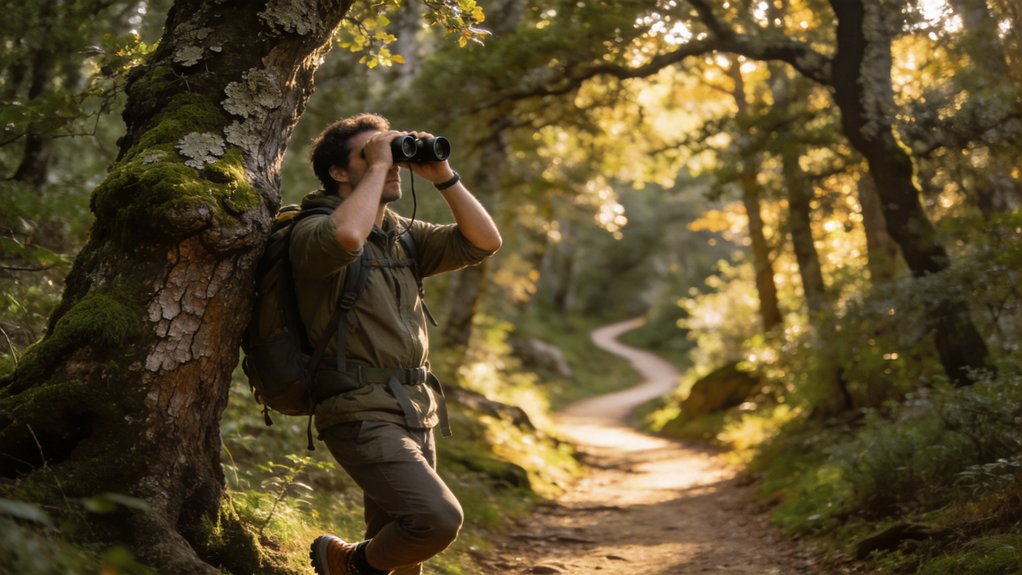
Soft footsteps preserve bird behavior. Species that would flush and vanish at a heavy footfall stay in their natural routines, so you see feeding patterns and movements you’d otherwise miss.
Learning a handful of regional calls lets you identify birds hiding in dense foliage before you ever see them.
Pay attention to sound. That skill comes faster than most people expect.
Pair visual scanning with active listening. The two together reveal far more than either alone.
Wake Up Early: Most Birds Sing at Dawn
Birds are most active and vocal between 5 AM and 9 AM.
That window is known as the dawn chorus, the period when birds sing to establish territory and attract mates.
Here’s why the early start pays off:
- Bird vocalizations are most intense during these hours, making identification easier
- Soft morning light improves visibility and photography opportunities
- Fewer hikers mean less disturbance to wildlife
- Certain behaviors are only visible in the early hours
Even arriving at the trailhead by 7 AM puts you in the active window. It doesn’t have to be a pre-dawn alarm.
Learn Common Bird Calls Before Your Hike
When birds hide in dense foliage, calls are often the only reliable clue.
You’ll usually hear a bird before you see it.
Apps like Merlin Bird ID and the National Audubon Society’s Audubon Bird Guide provide audio samples of species common to your area.
Listen to a few distinctive calls, such as the Eastern Whip-poor-will’s clear whistle or the American Robin’s melodic song, until they click into place.
Practice on neighborhood walks or in your backyard.
Familiarity with a dozen calls changes what you hear on the trail.
Local birding clubs and online communities often run call-identification workshops. An hour there compresses weeks of solo listening.
Use Hiking Poles to Free Your Hands for Binoculars
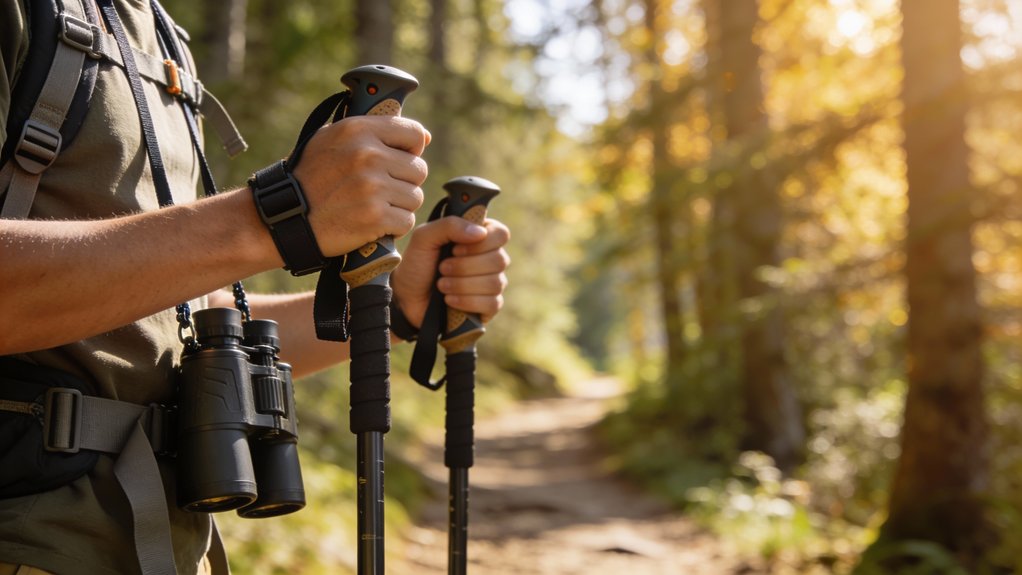
Poles tuck under your arm when you want to raise binoculars. That solves the most common frustration: needing both hands free at the exact moment you spot something.
Practical benefits on the trail:
- Better balance on uneven or sloped ground, so you can pause safely without gripping the poles
- Hands available for quick binocular adjustments without putting the poles down
- Stability that lets you focus on a bird rather than your footing
Set poles to a comfortable height and they stay out of the way until you need them.
Proper height means your elbow bends at roughly 90 degrees when you grip the handle. A quick adjustment at the trailhead is worth it.
Download the Merlin Bird ID App for Real-Time ID
Merlin Bird ID turns your phone into a birding tool that works without prior expertise.
No expertise required.
Enter size, color, and location and the app matches the bird against a database of over 7,500 species across North America and beyond. Audio recordings of songs and calls let you identify birds by sound.
The app updates regularly, so the information stays current.
Focus on Trails Near Water or Dense Forest
The most productive spots share two features: water and trees.
Here’s what makes these habitats reliable:
- Water trails attract waterfowl and shorebirds year-round
- Forest sections shelter songbirds and woodpeckers that stay hidden in thick foliage
- Spring and fall migration concentrate activity along these corridors as birds rest and feed
- Wetland plants like cattails create natural nesting and feeding grounds
Edge zones, where water meets woodland, are the most productive of all.
Stay patient in forested sections. Birds blend in well, and slow movement rewards you with sightings that faster hikers never get.
Connect With Local Birding and Hiking Groups
Local birding groups organize regular outings that pair hiking with on-the-spot identification. Knowledgeable guides who know the regional species and habitats help you learn far faster than going solo.
Community events like bird counts or conservation initiatives build friendships alongside practical skills. Many clubs run workshops on bird behavior and photography.
A group removes the uncertainty about where to go and what to expect. Starting with experienced birders compresses the learning curve considerably.
Walk slower, stop more often, listen before you look.
That change alone is enough to start noticing birds on every trail you already walk.