
What the two poles do is put more of your body to work on the same walk.
A physical therapist quoted by Harvard Health Publishing, the consumer health publisher of Harvard Medical School, puts numbers on it.
Regular walking uses about 50% to 70% of your muscles, she says, and Nordic walking uses up to 80% to 90%.
Those figures are one clinician’s estimate, not a study result.
Nordic walking is ordinary walking with a pole in each hand and a set arm rhythm.
Where Nordic walking comes from
Nordic walking began in Finland in the early 20th century. Cross-country skiers used it as a summer training routine, according to Harvard Health.
The poles give your hands something to push against. A second Harvard Health article says you have more ground contact points and are not relying on two feet alone.
With poles, you are not relying on two feet alone.
How it differs from hiking with trekking poles
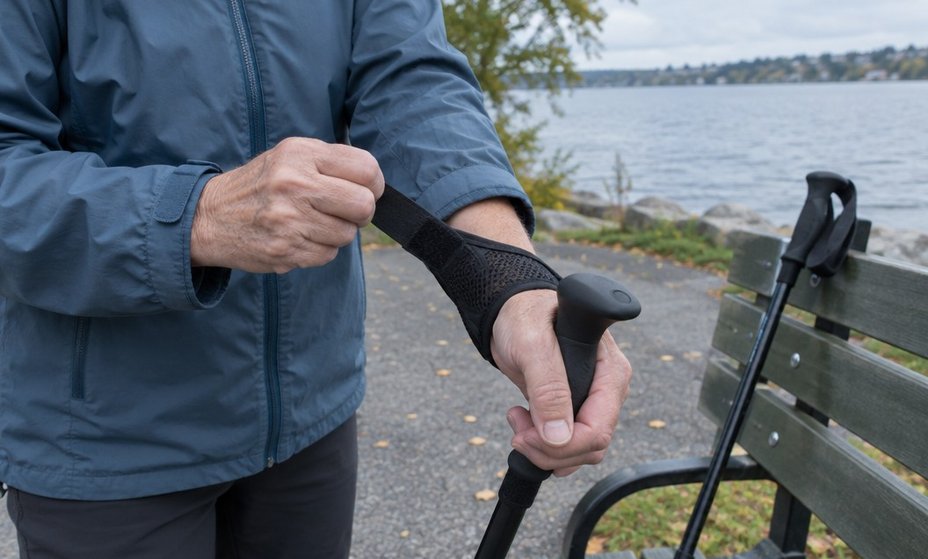
The two kinds of pole look alike and do different work.
The German pole maker LEKI describes trekking poles as designed for stability, control and versatility. Nordic poles are built for the diagonal whole-body gait on level ground.
Trekking poles steady you on rough ground. Nordic poles are made for a diagonal whole-body walk on level ground.
The grips differ too.
Trekking poles have loose wrist straps, while most Nordic poles come with a glove-like system, Harvard Health notes. It lets you push with your palm rather than your fingers.
If your walks are hikes on uneven trails, learn how to use trekking poles on hikes instead.
What studies and health bodies report
Harvard Health reports several benefits.
- Calories: studies cited there put the increase over regular walking at an estimated 18% to 67%.
- Joint stress: the physical therapist says force is spread through the poles and less through the legs. That reduces stress on the hips, knees and feet.
- Balance: Harvard Health says Nordic walking can help improve mobility and balance. The poles push you toward longer steps and away from a shuffling gait, which can raise the risk of falls.
- Cholesterol: it may help lower LDL cholesterol.
Cognition has its own evidence. A 2025 review in the journal Frontiers in Aging Neuroscience pooled eight studies with 327 participants, with an average age of about 71.
It found a significant effect on executive function, which covers things like planning and switching between tasks. It found no significant effect on global function, memory or attention.
The review found one cognitive effect and asks for caution. Its authors note that the number of included studies was relatively limited.
The diagonal technique, step by step
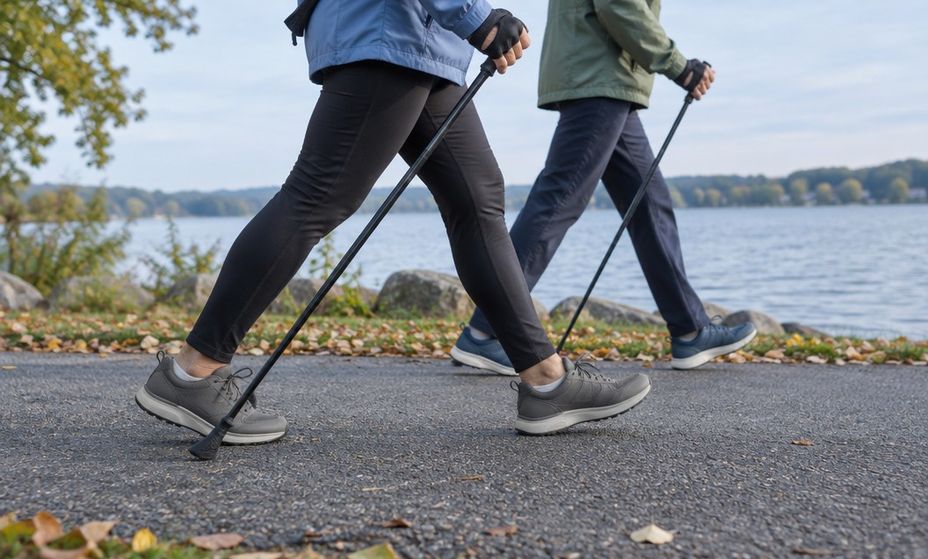
The basic gait pairs the right arm with the left leg, then the left arm with the right leg. This is the pattern LEKI teaches beginners.
- Slide your hand up through the strap from below, as the Swedish outdoor brand Silva describes.
- Step forward with your left foot and swing your right arm forward.
- Plant the pole just behind your foot, as Silva says, angled toward the back and not vertical, as LEKI’s beginner guide shows.
- Hold the grip firmly as the pole strikes. Let the tip push against the ground as your arm moves backward.
- Open your hand as you finish the push-off.
- Repeat on the other side: right foot forward, left arm swings.
Opposite arm and leg move forward together, and the steps stay natural, not too big.
Before your first session
This is information, not medical advice.
Anyone with a health condition should check with their doctor first.
When you are ready to buy, read about choosing Nordic walking poles and their length. After a walk, try these gentle outdoor stretches after 60.
Harvard’s physical therapist suggests starting on level surfaces like neighborhood sidewalks or a walking path.
On your first walks, use the poles for only about a quarter of your usual walk, on a level sidewalk or path.