
Kayaking uses muscles you don’t typically exercise in daily life, particularly your shoulders, back, and core.
Most beginners don’t realize this until the morning after their first paddle.
Ten to fifteen minutes of preparation is all it takes. Many beginners focus on choosing the right kayak but overlook this step. Simple stretches before and after paddling prevent soreness and injury. No gym membership or special equipment required.
Why Preparation Matters
Kayaking primarily uses your shoulders, back, core, and forearms in rotational movement patterns different from most daily activities.
Cold muscles are more prone to strains and pulls than warmed-up, flexible muscles.
Five minutes of stretching prevents days of soreness. This is especially true for people who sit at desks regularly, since office work creates tight shoulders and hips.
When to Do These Stretches
Before paddling (most important): Arrive at the water and complete these stretches before getting in your kayak. The full routine takes 8 to 10 minutes.
Short on time? Do at minimum the first three stretches, about 5 minutes, which covers the primary paddling muscles.
After paddling (helpful but optional): Stretching after kayaking prevents next-day stiffness. This takes 5 to 7 minutes and uses the same stretches with longer hold times. Focus on the muscle groups that feel most worked.
At home between trips: Doing these stretches three times weekly builds flexibility gradually. This helps if you have limited flexibility or plan to kayak regularly throughout the season.
The Six Essential Stretches
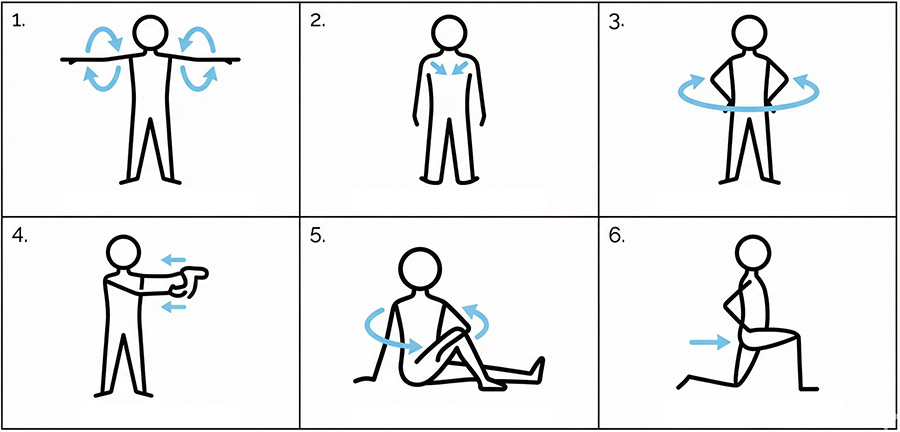
1. Shoulder Circles and Arm Swings
Why this matters: Increases range of motion in your shoulder joints, which do most of the work during paddling.
How to do it: Stand with feet shoulder-width apart. Make large circles with both arms simultaneously, forward for 10 circles, then backward for 10. Move slowly through the full range of motion.
Next, swing both arms across your chest and back out to the sides, like a wide hug opening and closing. Repeat 10 times.
You should feel warmth developing in your shoulders, not pain.
Common mistake: Moving too quickly or making small circles. Bigger, slower movements work better.
2. Shoulder Blade Squeeze
Why this matters: Strengthens upper back muscles that stabilize your paddling stroke, and counteracts the rounded shoulders that develop from desk work and driving.
How to do it: Stand or sit upright with arms relaxed at your sides. Squeeze your shoulder blades together as if holding a pencil between them. Hold for 5 seconds, release fully. Repeat 10 times.
For a more challenging version, extend your arms forward at shoulder height, palms facing each other. Pull your elbows straight back while squeezing. This adds resistance and builds more strength.
Focus point: Keep your shoulders down, away from your ears. The movement happens in your upper back, not your neck.
3. Torso Rotation Stretch
Why this matters: Kayaking requires constant torso rotation with each paddle stroke. This stretch prepares your core and lower back for the twisting motion you’ll repeat hundreds of times.
How to do it: Stand with feet shoulder-width apart and hands on your hips. Keeping your hips facing straight forward, rotate your upper body to the right as far as comfortable.
Hold 3 seconds, return to center, then rotate left. Repeat 10 times to each side.
For a deeper stretch, hold your paddle or a broomstick across your shoulders behind your neck. The added leverage increases the rotational stretch.
Breathing tip: Exhale as you rotate into the stretch, inhale as you return to center.
4. Wrist Flexion and Extension
Most paddlers focus on shoulders. Wrists are the part that cramps.
Why this matters: Gripping the paddle for extended periods strains your wrists and forearms. This stretch prevents cramping in these smaller muscle groups that fatigue quickly.
How to do it:
- Extend your right arm forward, palm facing down. Use your left hand to gently pull your right fingers toward you until you feel a stretch through your forearm (wrist flexion). Hold 15 seconds.
- Flip your right palm up and use your left hand to pull your fingers down toward the floor (wrist extension). Hold 15 seconds.
- Repeat with your left arm. Do the full cycle twice per arm, about 2 minutes total.
Important: Use gentle pressure. You should feel a stretch, not pain.
5. Seated Spinal Twist
Why this matters: Increases flexibility in your spine and lower back, which are essential for effective paddling. A flexible spine also reduces your risk of lower back strain.
How to do it: Sit on the ground with both legs extended. Bend your right knee and place your right foot flat on the ground on the outside of your left knee.
Place your left elbow on the outside of your right knee, right hand on the ground behind you for support.
Gently twist your torso to the right, looking over your right shoulder. Hold 20 seconds. Return to center and repeat on the other side.
Modification: If sitting on the ground is difficult, do this in a chair. Sit sideways on the seat and twist toward the chair back, using the backrest to help pull into the twist.
6. Hip Flexor Stretch
Why this matters: Sitting in a kayak keeps your hips in a flexed position the whole time. Tight hip flexors cause lower back strain. This stretch is especially important for people who already sit at desks most of the day.
How to do it: Kneel on your right knee with your left foot flat on the ground in front of you, knee bent at roughly 90 degrees. Keep your torso upright and core lightly engaged.
Push your hips forward gently until you feel a stretch in the front of your right hip and thigh. Hold 20 seconds. Switch sides.
You can hold onto your kayak, a car, or a tree for balance.
Key point: Don’t arch your lower back to deepen the stretch. The feeling should be in your hip, not your back.
Your Routine at a Glance
Before paddling: full routine (8 to 10 minutes)
- Shoulder circles and arm swings: 1 minute
- Shoulder blade squeezes: 1 minute
- Torso rotation stretch: 1 to 2 minutes
- Wrist flexion and extension: 2 minutes
- Seated spinal twist: 2 minutes total, both sides
- Hip flexor stretch: 2 minutes total, both sides
Quick version when time is limited (5 minutes): Do exercises 1, 2, and 3 only. This hits the primary paddling muscles in your shoulders, upper back, and core.
After paddling (5 to 7 minutes): Use the same six exercises but hold the static stretches longer. Focus on your shoulders and wrists, which typically work hardest. This post-paddle routine helps reduce next-day soreness.
After paddling, hold the static stretches about 30 seconds instead of 15 to 20.
Building Strength Gradually
Flexibility improves over weeks and months, not overnight.
Don’t push to the point of pain. You want mild tension in the muscle, not sharp discomfort.
For people planning regular kayaking throughout the season, light resistance band exercises at home two or three times weekly help. Simple rowing motions with resistance bands strengthen the same muscles used in paddling.
The Mayo Clinic offers evidence-based stretching guidelines on proper technique and safety.
Listen to your body. Some stiffness after your first few kayaking trips is normal. Your body is adapting to new movement patterns.
Sharp pain, or soreness lasting more than two days, suggests you should ease up and stretch more thoroughly before and after paddling.
If you experience persistent pain, particularly in your shoulders or lower back, talk to a healthcare provider before continuing. Proper kayaking safety practices include knowing when to rest and recover.
A Few Extra Preparation Notes
Staying hydrated prevents muscle cramps. Drink water before, during, and after your paddle. A light snack 30 to 60 minutes before paddling gives your muscles fuel without causing digestive discomfort.
Dress in layers you can adjust. Cold muscles are more prone to injury, so stay warm during your stretching routine and remove layers once you’re paddling and warmed up.
For home training between trips, resistance bands are inexpensive and work well for paddling muscles. Seated rows, shoulder external rotations, and torso twists with bands all build the strength that makes paddling easier.
Making Stretching a Habit
When you arrive at the water excited to paddle, it’s easy to skip the warmup. Resist that urge, especially on your first several trips.
Your body hasn’t adapted to the paddling motion yet.
Ten minutes now prevents a day of not being able to lift your arms.
Skip it once and you’ll remember why you shouldn’t.
Many experienced kayakers stretch while companions are getting boats off vehicles or organizing gear. Make it part of your arrival routine, the same way you put on your personal flotation device.
Regular outdoor activities like kayaking, including their benefits for physical and mental health, are worth protecting with a little preparation. Kayaking eases stress, supports cardiovascular health, and gets you out on the water.
Preparing your body properly means you can keep enjoying those benefits rather than sitting out the next trip.
Start with these stretches on your very first kayaking trip, and they’ll become automatic before long. Once you’re comfortable on the water, kayaking safely is the next thing worth knowing well.