
About 40% of hiking injuries happen on trails rated “easy.” That’s not because easy trails are secretly dangerous. It’s because most hikers don’t know what the rating actually measures.
Trail difficulty ratings aren’t standardized, and that catches new hikers off guard.
A “moderate” trail in one park can be harder than a “hard” one in another. Knowing how to read the system before you go is the difference between a good day out and a bad one.
What Trail Difficulty Ratings Are and Why They Matter

Trail difficulty ratings classify trails by how physically and technically demanding they are. They take into account trail width, length, surface quality, and obstacles.
The goal is to help you choose a trail that matches your actual ability. They also guide maintenance priorities and tell you what conditions to expect before you set off.
The problem is that different regions use completely different systems. Australia and Canada use distinct scales. The UK uses color codes. New Zealand has its own grading. If you’re used to one system and hike somewhere that uses another, the rating on the sign may not mean what you think it does.
The Standard Rating Systems You’ll Encounter
The most common systems break down like this:
- Australia (AWTGS): six grades, from flat Grade 1 walks to Grade 5 expert routes
- Canada: a simpler three-tier scale from Easy to Route-level
- UK: color codes, Green, Blue, Red, and Black, each representing a step up in difficulty
- New Zealand: four grades, from short walks to expert backcountry routes
- IMBA: a technical difficulty scale designed for mountain biking, sometimes applied to mixed-use trails
The system that matters is the one used in the park you’re visiting. Look it up before you go. Don’t assume a rating from one country or region means the same thing somewhere else.
How Difficulty Systems Vary Across Regions
Even within a single country, ratings can vary by park or jurisdiction.
California measures trails by mileage and elevation gain rather than a named scale. Switzerland maintains separate systems for hiking and mountaineering. These differences are easy to miss if you’re not looking for them.
The practical takeaway: check the specific system the park or trail network uses. A trail listed as “moderate” in one state or country may be considerably harder or easier than a “moderate” trail somewhere else.
Ratings don’t travel across regions.
They don’t transfer, so don’t assume.
Why Distance Deceives: Elevation, Terrain, and Exposure
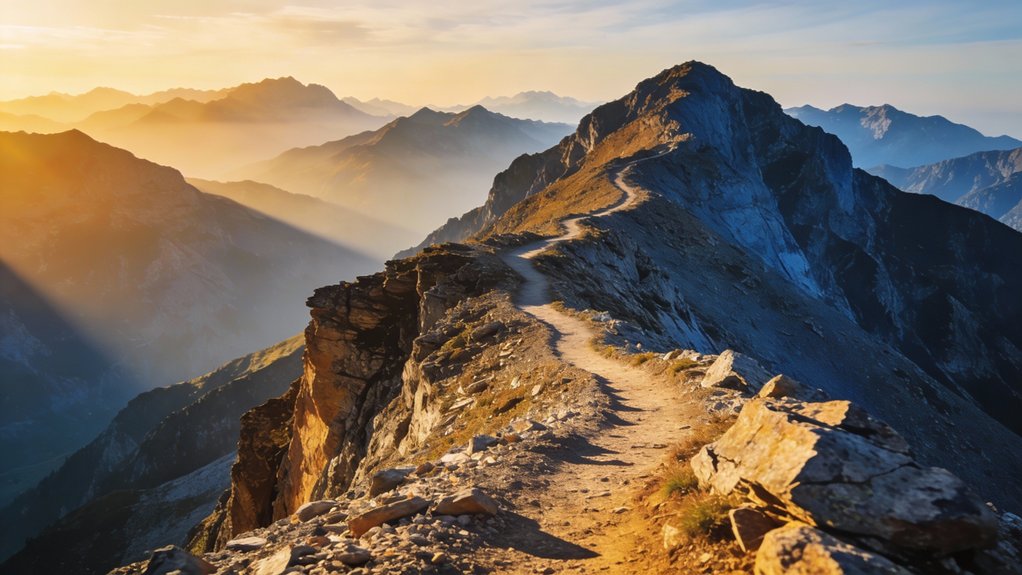
Distance is the easiest number to read on a trail sign.
It’s also the least useful on its own.
A 6-mile gradual climb feels easier than a steep 3-miler. Rocky or muddy terrain drains energy faster than a smooth path of the same length. Narrow ledges or sections with drop-offs add risk that mileage alone doesn’t capture.
Elevation gain, terrain type, and exposure together tell you more than the mileage does.
When you’re looking at a trail ahead of time, check all three. How much do you climb? What’s underfoot? Are there exposed sections where a slip matters? Getting specific on these questions tells you what you’re actually signing up for. It’s also worth checking the proper footwear for the terrain you’ll be on before you head out.
Research Trail Ratings Before You Hike
Knowing how the systems work is only useful if you apply it before you arrive at the trailhead.
Here’s a simple checklist for trail research:
- Find out which rating system the park or trail network uses
- Check both the average and peak ratings. They tell different stories (see below)
- Look at the specific terrain type and any technical requirements listed
- Verify that the trail’s demands match your current fitness and experience
Understanding techniques like ankle sprain prevention is also worth a look before you choose a trail with uneven ground. Smart preparation avoids most of the common problems.
Assess Your Fitness and Skill Level Honestly
Three things matter most when matching yourself to a trail: how far you can walk, what terrain you’ve handled before, and how your body manages elevation.
One useful benchmark is timing a 6-mile walk on flat ground. If you can do that comfortably, moderate trails are a reasonable next step. If not, stay with easier routes until flat distance feels manageable.
Rocky scrambles require different skills than smooth gravel paths.
Comfort on one terrain type doesn’t transfer to another.
Strenuous hikes can involve more than 2,500 feet of elevation gain. That number changes everything.
Know your actual limits, and respect them. Weather changes the calculation too. Rain turns a manageable trail into a slippery one.
Peak vs. Average: Which Rating Matters More?

Most trail ratings describe the average experience. That’s useful, but it only tells half the story.
Here’s how to use both numbers:
- The average rating reflects what you’ll experience on 50 to 75 percent of the trail
- The peak rating shows the hardest section you’ll actually face
- Together, they give you a complete picture
A trail rated 3 on average might hide a section that hits a 5 in difficulty.
The peak is what counts.
If you can handle the average but not the peak, you’ll find out at the worst possible point on the route. Check both before you go.
The peak rating is the one that catches unprepared hikers off guard.